AI Church Announcement Generator: Bulletins, Slides, and Scripts
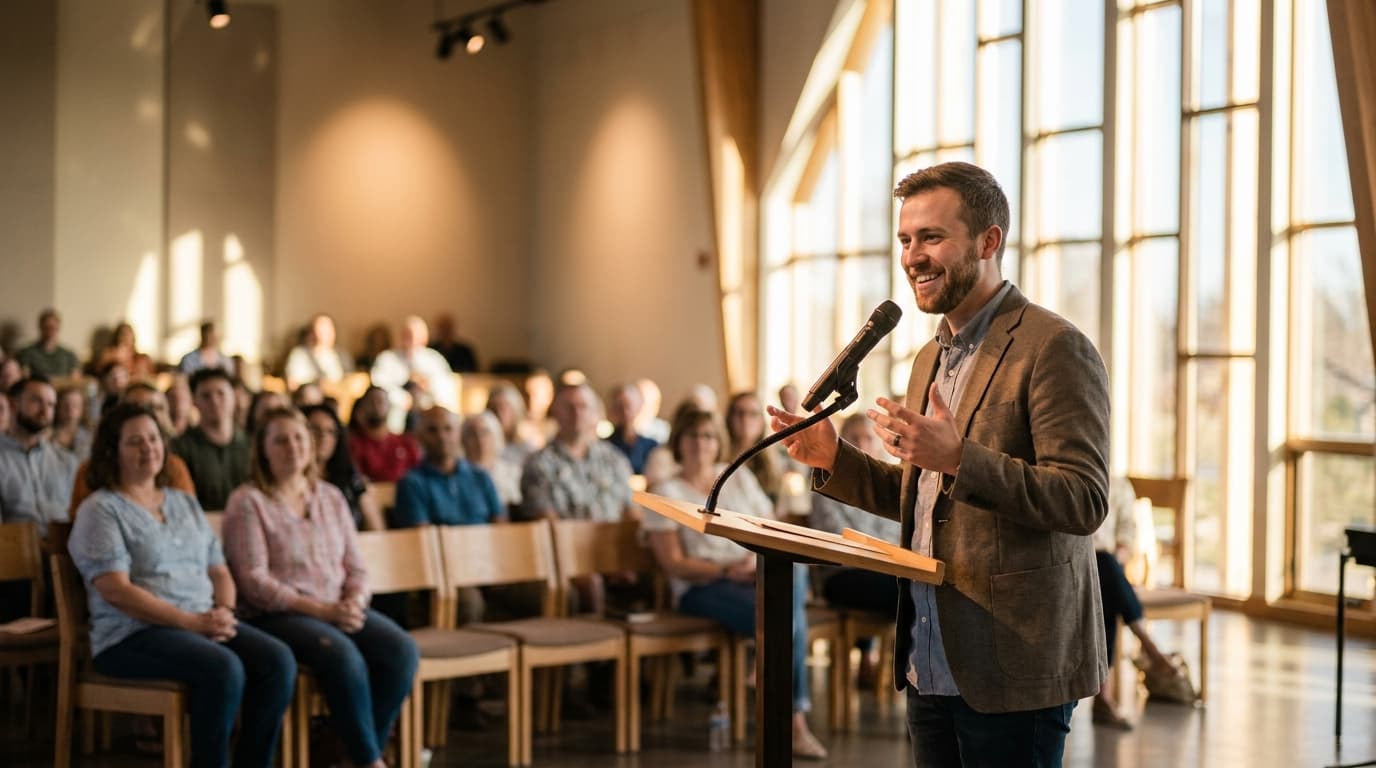
An AI church announcement generator is a tool that transforms your raw event details into polished, consistent communication for bulletins, projection slides, and verbal scripts. It eliminates the Sunday morning scramble by creating a single source of truth, ensuring your entire congregation hears the same clear message, no matter how they receive it.
Every church leader knows the feeling. It’s Saturday night, and the bulletin still isn’t finalized. The worship leader is asking for slide text. The youth pastor just added a last-minute event. You’re trying to craft a 30-second verbal announcement that doesn’t sound like a laundry list. The result is often inconsistent, stressful, and ineffective communication.
This isn’t just an administrative headache. Poor announcements have real spiritual and relational costs. When people miss events because the details were unclear, they miss opportunities for community and growth. When volunteers feel overwhelmed by the communication chaos, they burn out.
An AI-powered announcement generator doesn’t replace your pastoral voice or your team’s discernment. Instead, it acts as a tireless, skilled communications assistant. It takes your core information—the what, when, where, and why—and crafts it into the right format for every channel.
The Real Cost of Announcement Chaos
People Miss What Matters
When an announcement is buried in a cluttered bulletin or delivered as a rushed afterthought, people tune out. A men’s breakfast that could have fostered deep fellowship gets three sign-ups because the details were vague. The cost is measured in missed connections and unrealized ministry potential.
Volunteer and Staff Burnout
The announcement burden usually falls on one or two people—the overworked church administrator, or a faithful volunteer who spends hours every week chasing down information, reformatting text, and fixing errors. This repetitive task drains energy that could be spent on more strategic or relational work.
Inconsistent Messaging Erodes Trust
The bulletin says the small group starts at 6:30 PM. The projection slide says 7:00 PM. The pastor verbally announces 6:30 but adds, “Maybe closer to 7.” This inconsistency creates confusion, frustration, and a subtle erosion of trust. People begin to doubt the reliability of church communications.
Announcement Fatigue Sets In
When every Sunday features a long, undifferentiated list of announcements, people stop listening. The important gets lost in the trivial. A critical call for nursery volunteers is sandwiched between the church picnic reminder and the book club update.
How AI Church Announcement Generators Actually Work
Think of this technology not as a robot replacing your communications director, but as a powerful co-pilot that handles the heavy lifting of formatting and consistency.
Step 1: The Single Source of Truth
The workflow begins with a simple, centralized input. A staff member submits the core details: event name, date/time, location, target audience, brief description, and the call to action. This becomes the master record.
Step 2: AI-Powered Content Generation
From that single input, the AI generates multiple, tailored versions:
- Bulletin Text: A concise, print-ready paragraph with clear headings and bullet points.
- Projection Slides: One key message per slide, minimal text, large fonts, and clear visual hierarchy.
- Verbal Announcement Script: A 30-45 second script in conversational tone with a compelling hook, the why first, essential logistics, and a specific next step.
Step 3: Human Review and Pastoral Refinement
This is the most critical step. The AI provides the draft; your team provides the soul. You review for theological alignment, pastoral tone, and accuracy. The AI saves you 80% of the time, so you can invest your energy in the 20% that requires human wisdom.
Step 4: Seamless Distribution
The bulletin text goes to the printer. The slides are exported to ProPresenter or EasyWorship. The script is sent to the announcement speaker. Everything is aligned and consistent.
Case Study: From Chaos to Clarity at Riverbend Community Church
Riverbend Community Church in Portland, Oregon, was a vibrant congregation of 400. But their communication was a bottleneck. The office administrator spent her entire Friday piecing together announcements. The worship leader received slide text late Saturday night. The pastor had to ad-lib his announcements because the script didn’t match the slides.
The Solution: They implemented an AI announcement generator. Event coordinators submit requests through a simple online form by Tuesday. On Wednesday, the admin uses the AI to generate drafts. She spends 30 minutes refining them, then sends to staff for review.
The Transformation:
- Admin prep time dropped from 4 hours to 45 minutes.
- Perfect consistency across bulletin, slides, and verbal announcement.
- Online registrations for events increased by 40% within two months.
- Reduced stress across the team.
“The biggest win was trust,” says Pastor David Park. “Our people now trust that what they read in the bulletin is what they’ll hear from me and see on the screen.”
Crafting Announcements That Actually Move People
Prioritize Ruthlessly: The 3-5 Rule
Aim for no more than 3-5 announcements in any given service. Let data help you decide what makes the cut.
Master the 30-Second Rule
If you can’t explain the core of an announcement in 30 seconds, it’s too complex for a verbal spot. The AI generator distills your detailed description into a punchy, conversational script.
Lead with “Why,” Not “What”
Don’t start with “The annual potluck is next Saturday.” Start with, “One of the best ways to deepen friendships in our church family is to share a meal together.” AI tools can be programmed to adopt this benefit-first language.
Create Unmissable Calls to Action
“Sign up in the lobby” is weak. “Visit the welcome table after service to grab a registration form and a free coffee” is strong. Be specific, tangible, and immediate.
Optimizing Each Communication Channel
The Bulletin: Your Reference Document
AI ensures it is scannable (clear headings, bold text, bullet points), concise, and consistent.
Projection Slides: Your Visual Hook
AI-generated slides follow the one-idea-per-slide rule, use minimal text with large fonts, and suggest visual hierarchy.
Verbal Scripts: Your Conversational Bridge
The spoken announcement is your chance to add warmth and urgency. A good AI-generated script provides a conversational hook, the why first, clear logistics, and a specific call to action.
Integrating Announcements Across All Church Channels
Email Newsletters
The AI expands bulletin text for your mid-week email, adding hyperlinks and segmenting your list.
Social Media
Each platform has its own language. The AI generates Facebook/Instagram posts, Stories, and Twitter versions.
Church Website and App
AI generates compelling, SEO-friendly event descriptions with clear registration paths.
Text/SMS Reminders
For time-sensitive announcements, the AI distills the message to 160 characters.
The Weekly Announcement Workflow
- Monday: Event coordinators submit all requests via a shared form. Deadline: 5 PM.
- Tuesday: Communications team reviews submissions, prioritizes, confirms details.
- Wednesday (AI Day): Create drafts of bulletin, slides, and scripts. 30-60 minutes.
- Thursday: Circulate drafts to staff for review and approval.
- Friday: Finalize all materials. Load slides. Send bulletin to print. Email script to speaker.
- Saturday: Rest. Everything is done.
- Sunday: Execute with confidence.
Beyond Sunday: Reducing Fatigue and Increasing Impact
- The 2-Week Push: Give major events a two-week cycle. Week 1: the big why and initial details. Week 2: the urgent reminder and final CTA.
- Rotate Voices: Have different staff or lay leaders give announcements.
- Vary the Format: Sometimes a 60-second video testimony is more powerful than a spoken announcement.
- Segment Your Audience: Not every announcement is for everyone.
Choosing the Right AI Tool for Your Church
Look for ease of use, customization, integration with your existing software, and doctrine-awareness. A tool built for the church, like AlignedAI, understands the nuances of ministry communication and won’t generate content that conflicts with your theological stance.
Related reading
Frequently Asked Questions
Will an AI tool make our announcements sound robotic or generic? Not if you use it correctly. The AI provides a strong, consistent draft. Your team’s final review and customization add the pastoral warmth. The goal is to eliminate the scramble, not the soul.
How much time can we realistically save each week? Most churches report saving 3-5 hours per week on communication tasks.
Is this only for large churches with big staffs? Absolutely not. Smaller churches with limited staff often benefit the most. It allows a single administrator to produce professional, multi-channel communications.
How do we handle sensitive or pastoral announcements? These announcements require a distinctly pastoral tone and should always be handled with human oversight. An AI tool can help draft a compassionate notice, but the final wording must be carefully reviewed by pastoral staff.
Frequently asked questions
What is an AI church announcement generator?
A tool that takes event details and creates formatted bulletins, projection slides, and announcement scripts with consistent messaging across all formats.
How does AI help with church bulletins?
AI formats text consistently, suggests layout improvements, generates concise copy, and creates versions for print and digital.
Can AI create projection slides?
Yes. AI distills announcements into concise, slide-friendly text and some tools generate visual designs matching your branding.
How many announcements should we make on Sunday?
Limit to 3-5 items maximum. More than that causes fatigue where people tune out.
What is the best way to structure an announcement?
Lead with why the event matters, provide the what/when/where, end with a clear call to action.
Can AI reduce announcement fatigue?
Yes. AI suggests prioritization, rotation strategies, and format variations to keep announcements fresh.
How do we keep announcements consistent across formats?
An AI generator creates a single source of truth. All formats are generated from the same details.
Should we still print a bulletin?
Many churches find bulletins valuable for older members. AI makes creation easy enough to maintain.
How far in advance should we plan announcements?
At least one week. This gives time for quality content without scrambling.
Can AI help with follow-up after Sunday?
Yes. AI repurposes content into emails, social posts, and text messages extending reach beyond Sunday.
About this article
Published by Aligned Team, the doctrine-aware AI platform built for pastors and church leaders. Every article is grounded in Scripture and aligned to historic Christian doctrine.
Reviewed against the same doctrinal frameworks that power AlignedAI. See our editorial standards.
Published June 5, 2026. Last updated June 19, 2026.
Spotted an error or a claim that needs a source? Email our support team — we update the article and its date when a correction is warranted.
Comments
- No comments yet. Be the first to share your thoughts.