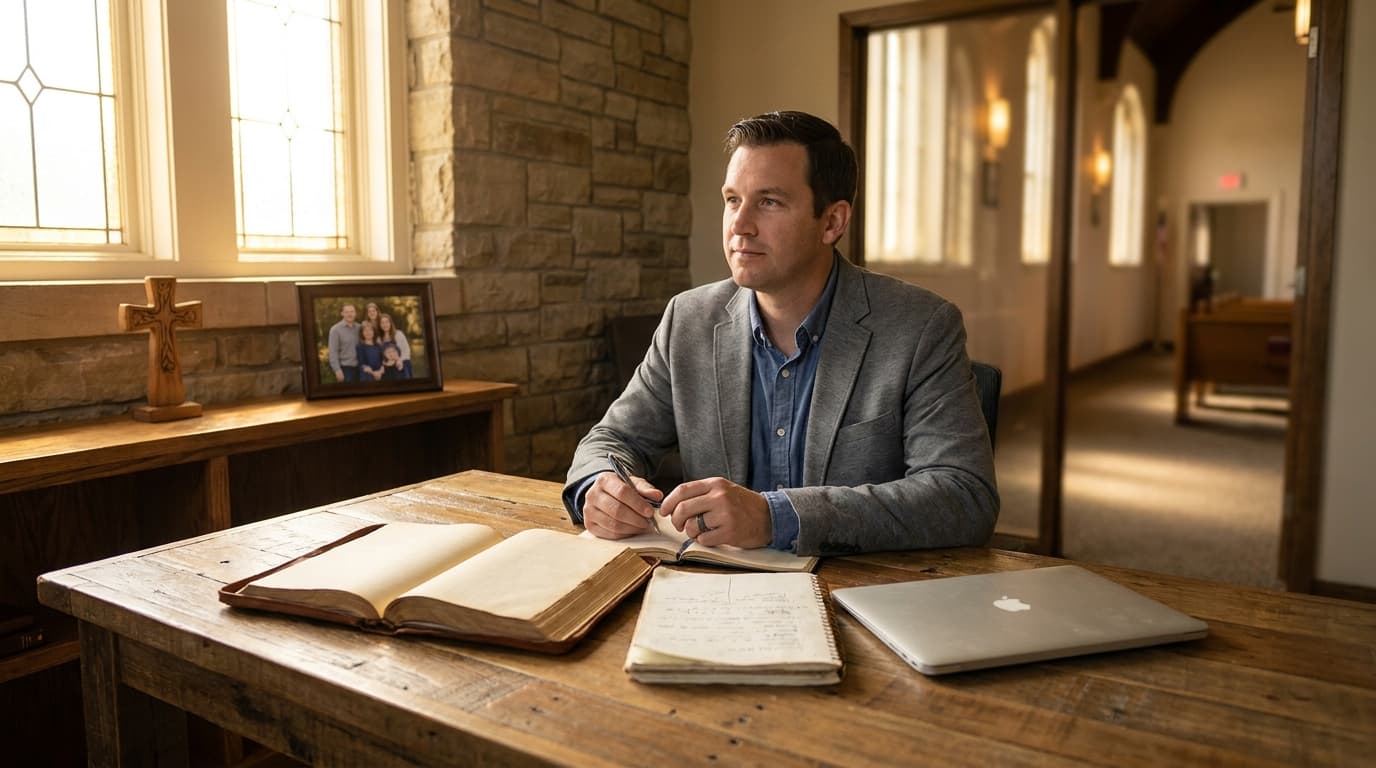
Best AI Book Writing Tools for Pastors in 2026

The best AI book writing tools for pastors in 2026 help you turn sermon series, Bible studies, and ministry experience into publish-ready book manuscripts. Aligned converts sermon archives into book chapters and outlines, Scrivener organizes the manuscript, and Claude or ChatGPT assists with drafting and editing. ProWritingAid polishes the final prose.
Why Pastors Should Write Books in 2026
Every pastor has at least one book inside them. You have spent years studying Scripture, counseling families, leading congregations, and wrestling with the text. That experience has produced insights that could help thousands of people beyond your church walls.
Writing a book is also one of the most effective ways to:
- Extend your ministry impact beyond your congregation
- Establish credibility as a thought leader in your denomination or network
- Create a resource that disciples people even when you are not in the room
- Generate passive income that supports your family or ministry
- Leave a legacy that outlasts your pastoral tenure
The barrier has always been time. Between sermon prep, pastoral care, and administrative duties, finding 200 to 300 hours to write a book feels impossible. AI tools compress that timeline dramatically.
How AI Changes the Book-Writing Process for Pastors
Traditional book writing for pastors looks like this:
- Spend 6 to 12 months gathering notes and ideas
- Write an outline during a retreat or sabbatical
- Draft chapters in stolen hours between Sundays
- Revise over another 6 months
- Total timeline: 18 to 24 months
With AI tools, the process becomes:
- Feed your sermon archive into Aligned to generate a book outline from your best sermon series
- Use Claude or ChatGPT to expand each outline section into a rough chapter draft
- Rewrite and personalize each chapter with your stories and theological depth
- Use ProWritingAid to polish the prose
- Total timeline: 3 to 6 months
The key word is assist. AI handles the structural and drafting work. You handle the theology, stories, and pastoral voice that make the book uniquely yours.
The 7 Best AI Book Writing Tools for Pastors
1. Aligned — Best for Sermon-to-Book Conversion
Aligned has a unique advantage for pastors: it can take a sermon series and generate a book outline with chapter summaries, key themes, and supporting Scripture references.
How it works:
- Select a sermon series (4 to 12 sermons work best)
- Aligned analyzes the theological arc across the series
- It generates a book outline with:
- Chapter structure organized by sermon themes
- Key theological points per chapter
- Supporting Scripture references
- Suggested illustrations and application points
- Introduction and conclusion frameworks
- You expand each chapter with your own stories and insights
Pricing: Free tier available; paid plans scale with usage.
Best for: Pastors who want to turn a sermon series into a book structure.
2. Scrivener — Best for Manuscript Organization
Scrivener is the industry standard for book writing software. Its organizational tools are unmatched for long-form projects.
Features for pastors:
- Binder system to organize chapters, sections, and research notes
- Corkboard view for visual chapter planning with index cards
- Split-screen to reference sermon transcripts while writing
- Target word count tracking per chapter and total
- Compile to Word, PDF, ePub, or Kindle format
- Snapshot feature for version control (save before major revisions)
Church use case: Import your sermon transcripts as research documents, create chapter cards for each sermon-based chapter, and write in a distraction-free full-screen mode.
Pricing: One-time purchase of $49.
Best for: Any pastor writing a book, regardless of length or genre.
3. Claude — Best for Long-Form Drafting
Claude by Anthropic has a 100K+ token context window, making it ideal for working with book-length documents. It maintains consistency across long pieces better than any other AI tool.
How pastors use Claude for book writing:
- Paste an entire sermon series and ask Claude to identify the narrative arc
- Generate chapter-by-chapter outlines from sermon themes
- Draft individual chapters from detailed outlines
- Rewrite sections for clarity and accessibility
- Generate discussion questions for each chapter (useful for small group editions)
Pricing: Free tier available; Pro at $20/month.
Best for: Pastors who need help drafting and expanding chapters from sermon material.
4. ChatGPT — Best Budget Option for Brainstorming
ChatGPT is excellent for brainstorming book ideas, generating outlines, and drafting rough content. Its limitations in long-form consistency make it better for shorter sections.
How pastors use ChatGPT:
- Brainstorm book titles and subtitles
- Generate chapter outlines from sermon notes
- Draft introduction and conclusion paragraphs
- Create discussion questions for each chapter
- Rewrite complex passages in simpler language
Pricing: Free tier available; Plus at $20/month.
Best for: Pastors who need brainstorming help and short-form drafting assistance.
5. ProWritingAid — Best for Editing and Polish
ProWritingAid provides the deepest writing analysis available, with 20+ reports on style, pacing, readability, and consistency.
Features for book writing:
- Style report: identifies overused words, passive voice, and sentence length issues
- Pacing report: flags sections that are too dense or too slow
- Readability report: ensures your book is accessible to your target audience
- Consistency report: catches spelling and hyphenation inconsistencies
- Dialogue report: useful if your book includes conversational illustrations
- Integration with Scrivener, Word, and Google Docs
Church use case: After drafting each chapter in Scrivener, run ProWritingAid to identify pacing issues, overused phrases, and readability problems before moving to the next chapter.
Pricing: Free tier available; Premium at $20/month.
Best for: Pastors who want professional-quality editing without hiring a full editor.
6. Grammarly — Best for Grammar and Clarity
Grammarly catches grammar errors, improves clarity, and ensures consistent tone. It is the last line of defense before a manuscript goes to a publisher.
Features:
- Grammar and spelling correction
- Tone detection and adjustment
- Clarity improvements for complex sentences
- Plagiarism detection (important when citing sources)
- Browser extension that works everywhere
Church use case: Run your final manuscript through Grammarly Premium to catch every typo and ensure the tone is consistent throughout.
Pricing: Free tier available; Premium at $12/month.
Best for: Final manuscript review before submission to a publisher.
7. Atticus — Best for Book Formatting and Publishing
Atticus is a book writing and formatting tool that handles the final step: turning your manuscript into a published book.
Features:
- Writing environment similar to Scrivener
- Professional book formatting for print and eBook
- Export to Kindle, ePub, PDF, and print-ready PDF
- Template library for chapter styling
- Collaboration features for co-authored books
Church use case: After writing and editing your book in Scrivener, import the manuscript into Atticus for professional formatting and export to Kindle and print-ready PDF.
Pricing: One-time purchase of $147.
Best for: Pastors who want to self-publish their book professionally.
The Pastor's Book-Writing Workflow with AI
Phase 1: Outline (Week 1 to 2)
- Choose your best sermon series (4 to 12 sermons)
- Upload sermons to Aligned to generate a book outline
- Review and restructure the outline in Scrivener
- Use Claude to expand each chapter outline with sub-points
Phase 2: Draft (Weeks 3 to 12)
- Write 1 to 2 chapters per week using Scrivener
- Use Claude to generate rough drafts of sections you are struggling with
- Rewrite every AI-generated section in your own voice with personal stories
- Track progress with Scrivener word count targets
Phase 3: Edit (Weeks 13 to 16)
- Run ProWritingAid on each chapter for style and pacing
- Use Grammarly for final grammar and clarity check
- Read every chapter aloud to catch awkward phrasing
- Get feedback from 2 to 3 trusted readers
Phase 4: Format and Publish (Weeks 17 to 18)
- Import final manuscript into Atticus for formatting
- Export to Kindle, ePub, and print-ready PDF
- Upload to Amazon KDP, IngramSpark, or your preferred platform
Real Pastor Case Study: From Sermon Series to Published Book in 4 Months
Pastor Michael had been preaching through the book of James for 14 months. He had 14 sermon transcripts totaling 70,000 words. He always wanted to turn the series into a book but could not find the time.
His AI-powered workflow:
- Week 1: Uploaded all 14 sermons to Aligned. Generated a 12-chapter book outline with theological themes organized for a book format rather than a sermon format.
- Weeks 2 to 8: Wrote one chapter per week in Scrivener. Used Claude to draft the first 2,000 words of each chapter, then rewrote in his own voice with personal stories and congregational illustrations. Average: 5 hours per chapter.
- Weeks 9 to 10: Ran ProWritingAid on every chapter. Fixed pacing issues in chapters 4 and 8 (too dense). Simplified theological language in chapter 11 for accessibility.
- Week 11: Grammarly final review. Read the entire manuscript aloud over 3 days.
- Weeks 12 to 14: Formatted in Atticus. Published on Amazon Kindle and ordered 200 print copies for his church.
Total time invested: approximately 70 hours over 14 weeks (5 hours per week)
"Without AI, this book would have taken me two years," Pastor Michael says. "The AI handled the structure and first drafts. I handled the theology, the stories, and the pastoral voice. The final product is genuinely mine — AI just made the process possible."
Ethical Considerations for Pastors Writing Books with AI
Your Name Goes on the Cover
If your name is on the cover, the content should reflect your thinking, your theology, and your voice. AI is a tool for drafting and organization, not a ghostwriter. Rewrite every AI-generated section in your own words.
Cite Your Sources
If your book references other theologians, commentators, or scholars, cite them properly. AI can help you find relevant references, but proper attribution is your responsibility.
Be Transparent (Optional but Recommended)
Some pastors choose to disclose their use of AI tools in the acknowledgments or introduction. This is a personal decision, but transparency builds trust with readers.
The Theology is Yours
AI does not have theological convictions. It does not understand the nuances of your denominational tradition. Every theological claim in your book must be reviewed and affirmed by you. AI helps with the writing process; you own the theology.
The Bottom Line
Writing a book as a pastor is no longer a multi-year project that requires a sabbatical. With AI tools like Aligned for sermon-to-book outlining, Scrivener for manuscript organization, Claude for drafting assistance, and ProWritingAid for editing, you can go from sermon series to published book in 3 to 6 months.
The content is already in your sermons. The AI helps you structure and draft it. You provide the theology, the stories, and the pastoral heart that make the book uniquely yours.
Write Sermons Free: 200 Per Month on AlignedAI
Pastors can draft up to 200 sermons per month at no cost on AlignedAI. Each outline, manuscript draft, illustration set, or prep request counts as one message on the free tier — enough for weekly preaching plus Bible studies and church communications.
Sign up free at aligned.church →
No credit card required. Configure your theological tradition, Bible translation, and church context during setup.
Related reading
Frequently asked questions
Can pastors use AI to write books?
Yes. AI tools help pastors organize sermon material into book outlines, draft chapters, and edit manuscripts. The pastor provides theology, stories, and pastoral voice while AI assists with structure and first drafts.
What is the best AI tool for turning sermons into books?
Aligned is the best AI tool for turning sermons into books because it analyzes sermon series and generates book outlines with chapter structure, theological themes, and supporting Scripture references.
Is it ethical for a pastor to use AI for book writing?
Yes, when AI assists with drafting and organization while the pastor maintains theological authority. Rewrite every AI section in your own voice, cite sources properly, and ensure all theological claims reflect your convictions.
How long does it take to write a book with AI?
With AI tools, most pastors can go from sermon series to published book in 3 to 6 months working 5 to 7 hours per week. Without AI, the same project typically takes 18 to 24 months.
What software do pastors use to write books?
Pastors use Scrivener for manuscript organization, Aligned for sermon-to-book outlining, Claude or ChatGPT for drafting assistance, ProWritingAid for editing, and Atticus for formatting and publishing.
Can AI maintain my pastoral voice in a book?
AI generates first drafts that you rewrite in your own voice. The best approach is to use AI for structure and rough content, then rewrite every section with your personal stories, theological depth, and pastoral tone.
Should I disclose AI use in my book acknowledgments?
This is a personal decision. Some pastors choose to mention AI tools in their acknowledgments as part of their writing process. Transparency builds trust with readers and there is no shame in using modern tools.
How much does it cost to self-publish a book as a pastor?
Self-publishing costs range from $200 to $2,000 depending on editing, cover design, and formatting. AI tools reduce costs by handling drafting and editing. Amazon KDP is free to publish on.
Can AI help with book editing and proofreading?
Yes. ProWritingAid analyzes style, pacing, readability, and consistency across a full manuscript. Grammarly catches grammar errors and improves clarity. Both integrate with Scrivener and Word.
What type of book should a pastor write first?
Start with a sermon series that resonated deeply with your congregation. A 6 to 8 sermon series on a practical topic like marriage, parenting, or spiritual growth makes an accessible first book.
About this article
Published by Aligned Team, the doctrine-aware AI platform built for pastors and church leaders. Every article is grounded in Scripture and aligned to historic Christian doctrine.
Reviewed against the same doctrinal frameworks that power AlignedAI. See our editorial standards.
Published June 5, 2026. Last updated June 19, 2026.
Spotted an error or a claim that needs a source? Email our support team — we update the article and its date when a correction is warranted.
Comments
- No comments yet. Be the first to share your thoughts.