The 2026 Pastors & AI Survey · Aligned Leader by AlignedAI
How Pastors Are Approaching AI: The 2026 Pastors & AI Survey
420 pastors and church leaders told us how they use AI, where they draw the line, and what they want their churches to know. A report by pastors, for pastors.
- Fielded
- October 5–26, 2026
- Respondents
- 420 pastors and church leaders
- By
- Jonathan Bodnar, Aligned Leader by AlignedAI
The short answer
How should pastors approach AI? Most pastors told us to treat it as a research assistant, not a spiritual authority. Use it to gather and organize. Check what it says against Scripture. Keep the sermon, the shepherding and the discernment in your own hands. And teach your church about it, because half of pastors say their people are already asking.
At a glance
51%
of pastors and church leaders say congregants have asked them how to approach AI as a believer (n = 414).
60%
of leaders at churches of 100 or more people have been asked about AI, compared with 47% at churches under 100.
14%
say Christians should use generic AI platforms like ChatGPT and Claude for spiritual guidance; 38% say no (n = 383).
73%
see an ethical way for pastors to use AI in leading a church, most with limits; 23% say no (n = 379).
43%
of pastors who explained said AI can help, but it shouldn’t decide what a church needs to hear (n = 143 written answers).
33%
told people to double-check AI, usually against the Bible, without being asked (n = 353 who wrote an answer).
68%
of the 115 respondents who described how they use AI named research and Bible study, the most common use.
35%
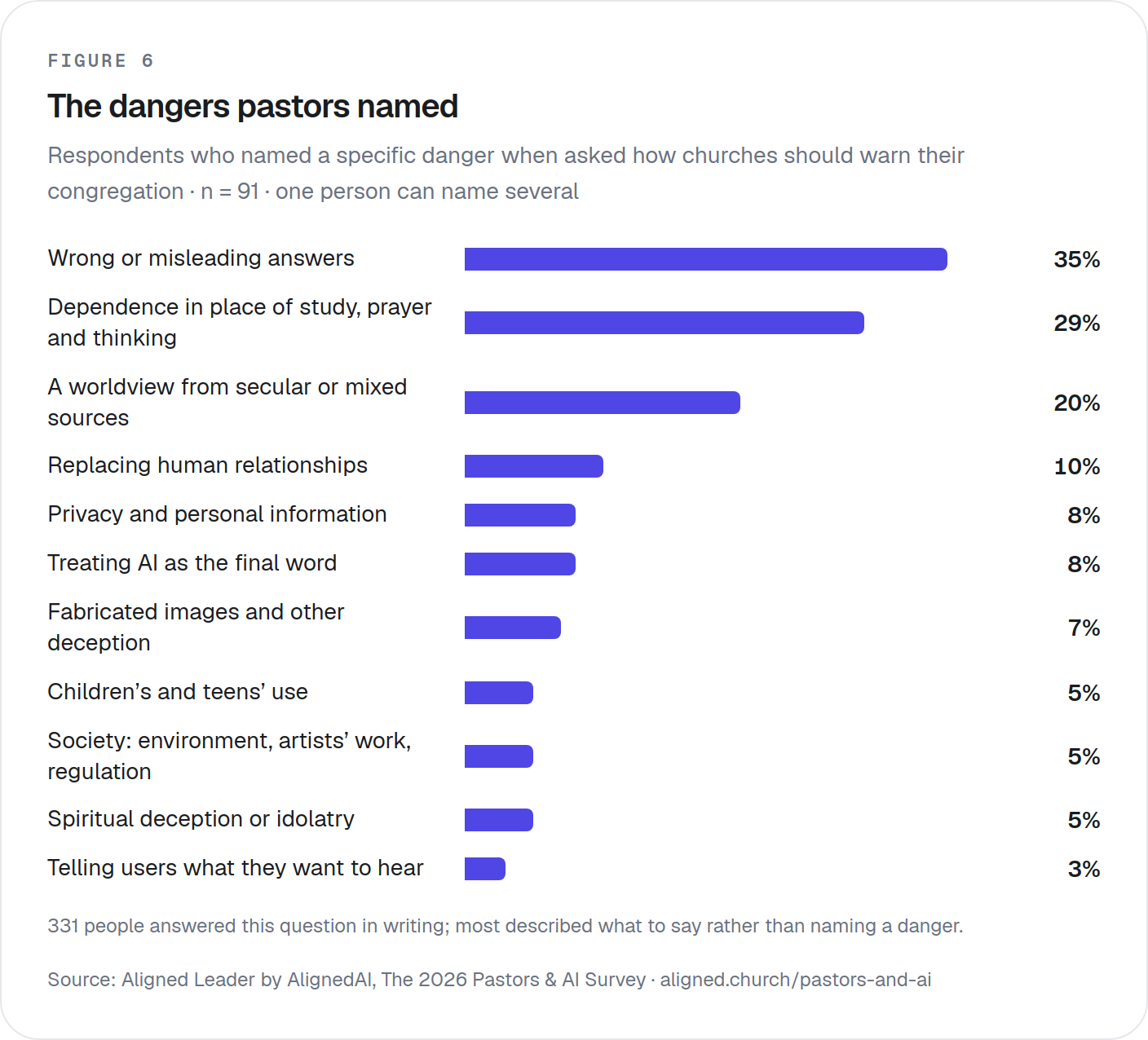
of pastors who named a danger pointed to wrong or misleading answers, followed by over-dependence (29%) and a worldview not drawn from Scripture (20%) (n = 91).
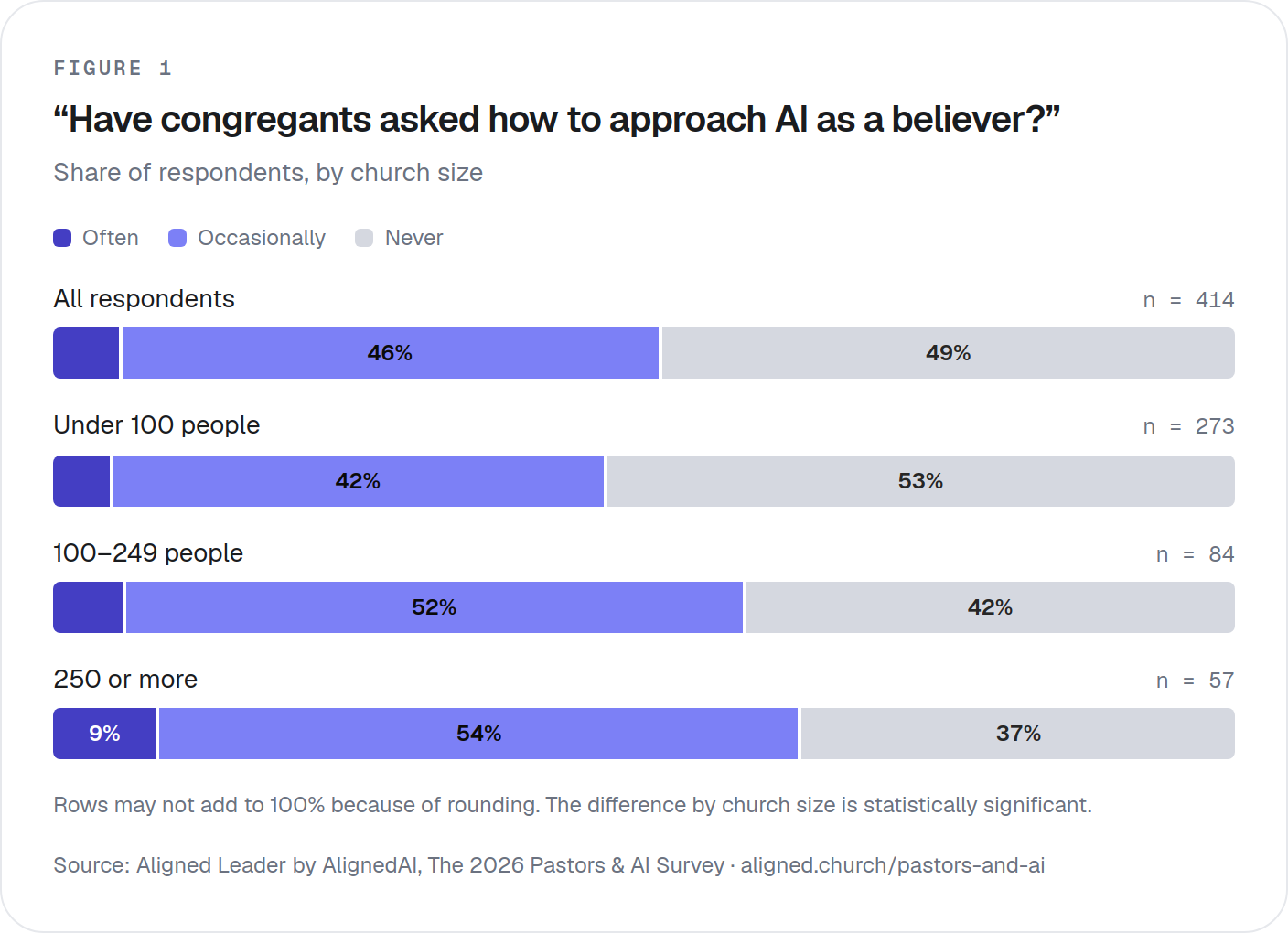
Half of the pastors and church leaders we surveyed (51%) say congregants have asked them how to approach AI as a believer. At churches of 100 or more people, it’s 60%.
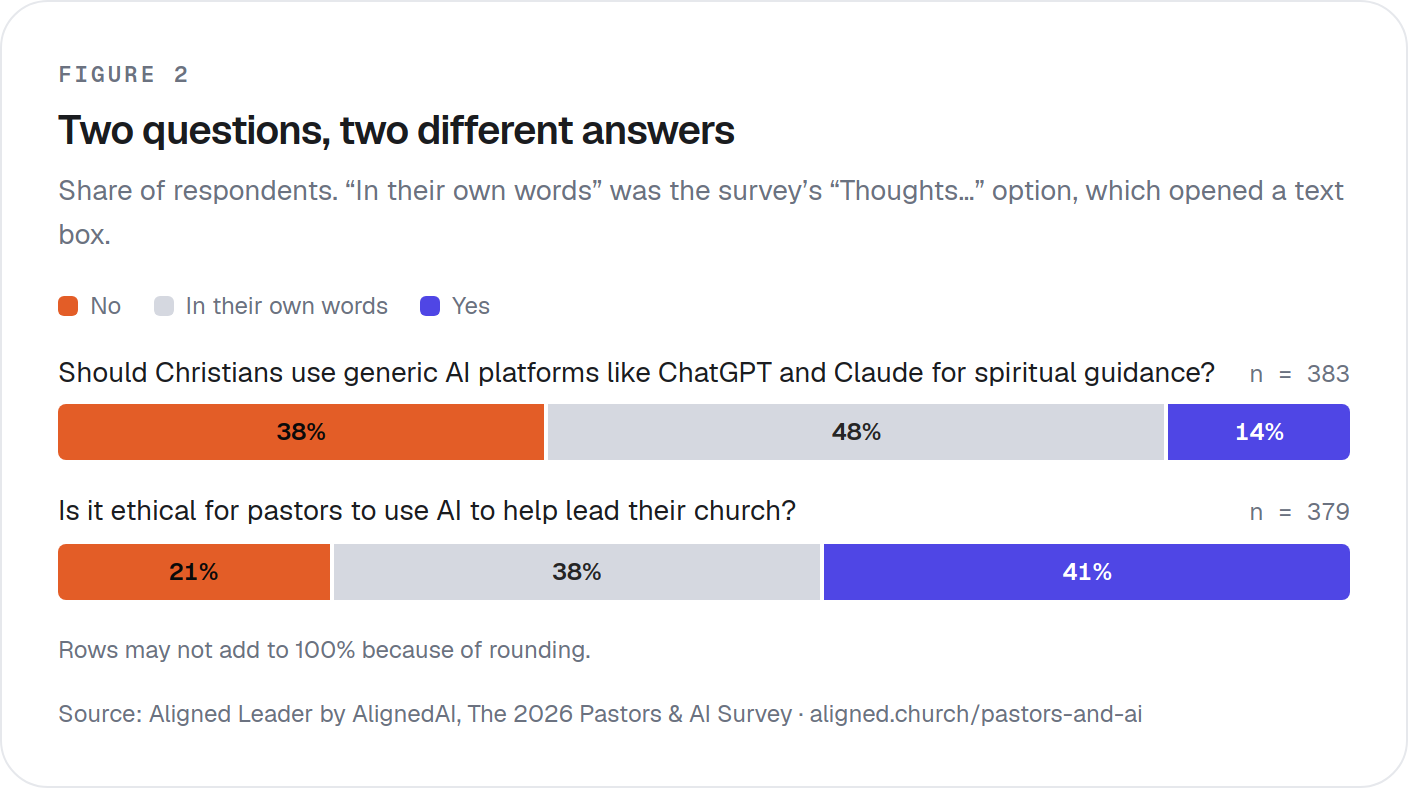
Only 14% say Christians should use generic AI platforms like ChatGPT and Claude for spiritual guidance, and 38% say no. Nearly half answered in their own words, most often “yes, if you check it against Scripture” or “for research, yes; for guidance, no.”
41% say it’s ethical for pastors to use AI to help lead their church and 21% say it isn’t. Counting written answers, 73% see an ethical way to use it. The most common condition: AI can help, but it shouldn’t decide what a church needs to hear.
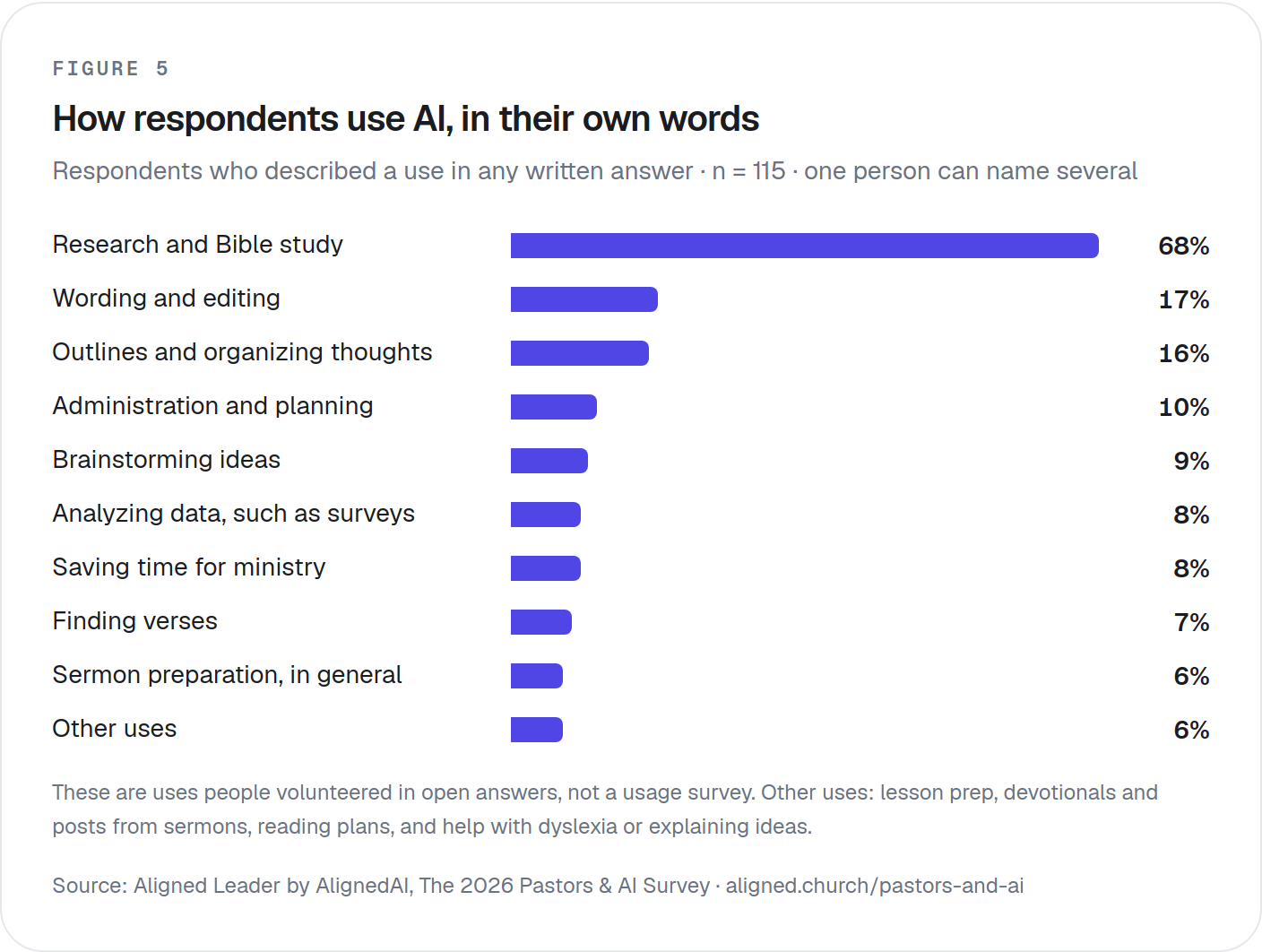
Research and Bible study is the most common way respondents use AI, named by 68% of those who described how they use it.
The dangers pastors name most are wrong answers (35%), over-dependence (29%) and a worldview that isn’t drawn from Scripture (20%).
To teach their churches, pastors most often suggest the pulpit, small groups and classes, and open conversation, with honesty about both the benefits and the dangers.
Are church members asking pastors about AI?
Yes. Half of the pastors and church leaders we surveyed (51%) say congregants have asked them how to approach AI as a believer: 189 occasionally and 23 often, of the 414 who answered.
The bigger the church, the more often the question comes up. At churches under 100 people, 47% of leaders have been asked. At churches of 100 or more, it’s 60%. Among the larger traditions in the survey, leaders of Pentecostal / Charismatic churches hear it most: 63%, compared with 49% of everyone else.
“Have congregants asked how to approach AI as a believer?”
Share of respondents, by church size
Have congregants asked how to approach AI as a believer?: All respondents: Often 6%, Occasionally 46%, Never 49% (n = 414); Under 100 people: Often 5%, Occasionally 42%, Never 53% (n = 273); 100–249 people: Often 6%, Occasionally 52%, Never 42% (n = 84); 250 or more: Often 9%, Occasionally 54%, Never 37% (n = 57). Source: Aligned Leader by AlignedAI, The 2026 Pastors & AI Survey.
- Often
- Occasionally
- Never
All respondentsn = 414
6% · Often · 23 of 41446% · Occasionally · 189 of 41449% · Never · 202 of 414Under 100 peoplen = 273
5% · Often · 13 of 27342% · Occasionally · 114 of 27353% · Never · 146 of 273100–249 peoplen = 84
6% · Often · 5 of 8452% · Occasionally · 44 of 8442% · Never · 35 of 84250 or moren = 57
9% · Often · 5 of 5754% · Occasionally · 31 of 5737% · Never · 21 of 57
Rows may not add to 100% because of rounding. The difference by church size is statistically significant.
Show table
| Often | Occasionally | Never | n | |
|---|---|---|---|---|
| All respondents | 6% | 46% | 49% | 414 |
| Under 100 people | 5% | 42% | 53% | 273 |
| 100–249 people | 6% | 52% | 42% | 84 |
| 250 or more | 9% | 54% | 37% | 57 |
We need to not let this go like we did the internet.
“I think they are going to ask; it’s the way that culture is shifting… I hope that they treat the Bible with more trust than an AI platform.”
“Dealing with AI is going to be a discipleship issue in the life of the church.”
Should Christians use ChatGPT for spiritual guidance?
Most pastors say no, or only with conditions. Just 14% said Christians should use generic AI platforms like ChatGPT and Claude for spiritual guidance, and 38% said no. The other 48% answered in their own words.
Two questions, two different answers
Share of respondents. “In their own words” was the survey’s “Thoughts…” option, which opened a text box.
Two questions, two different answers: Should Christians use generic AI platforms like ChatGPT and Claude for spiritual guidance?: No 38%, In their own words 48%, Yes 14% (n = 383); Is it ethical for pastors to use AI to help lead their church?: No 21%, In their own words 38%, Yes 41% (n = 379). Source: Aligned Leader by AlignedAI, The 2026 Pastors & AI Survey.
- No
- In their own words
- Yes
Should Christians use generic AI platforms like ChatGPT and Claude for spiritual guidance?n = 383
38% · No · 145 of 38348% · In their own words · 184 of 38314% · Yes · 54 of 383Is it ethical for pastors to use AI to help lead their church?n = 379
21% · No · 80 of 37938% · In their own words · 144 of 37941% · Yes · 155 of 379
Rows may not add to 100% because of rounding.
Show table
| No | In their own words | Yes | n | |
|---|---|---|---|---|
| Should Christians use generic AI platforms like ChatGPT and Claude for spiritual guidance? | 38% | 48% | 14% | 383 |
| Is it ethical for pastors to use AI to help lead their church? | 21% | 38% | 41% | 379 |
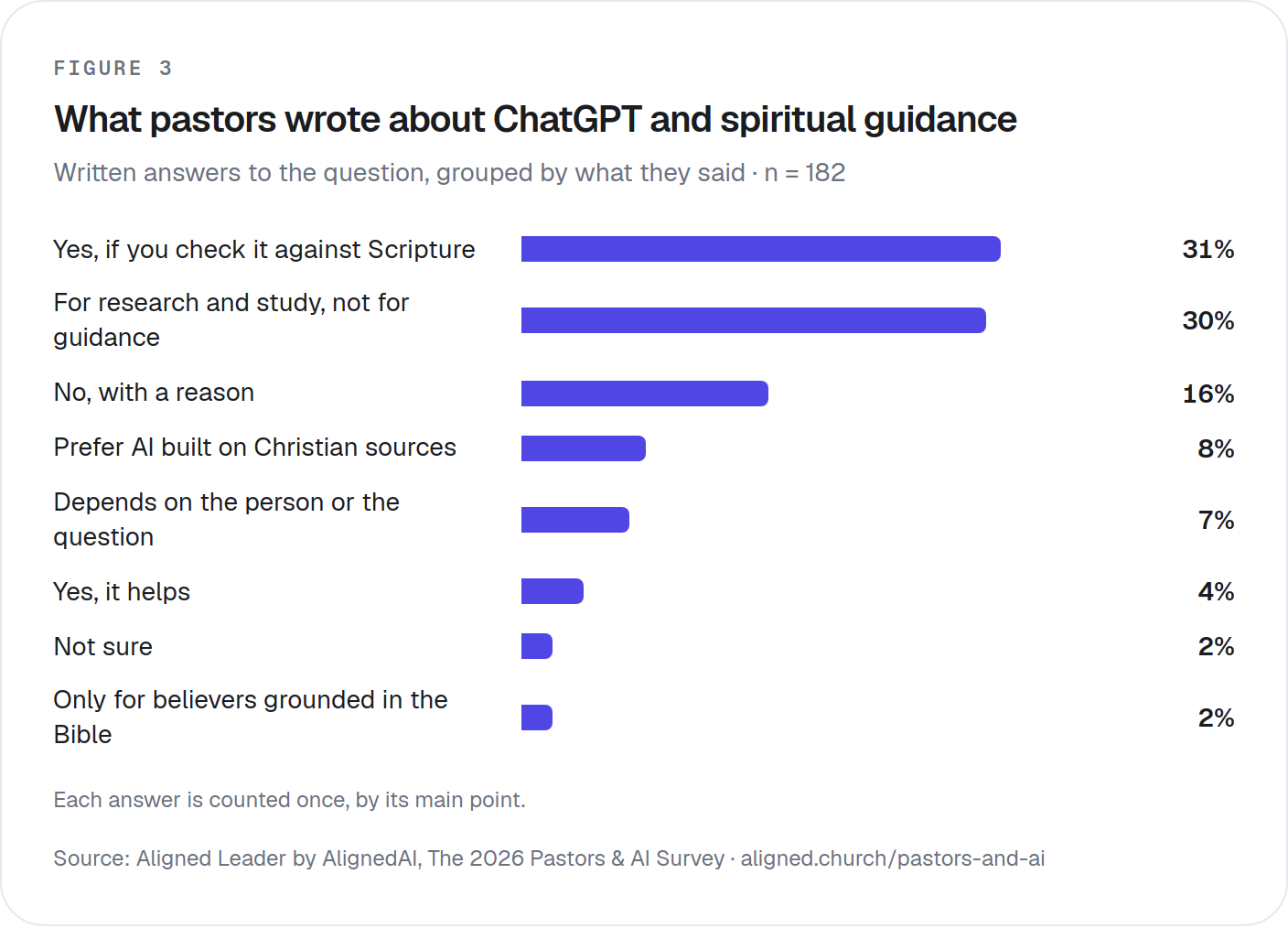
We read every written answer. The most common said yes, as long as the answer is checked against Scripture (31% of written answers). Almost as many drew a clear line between information and guidance: AI is fine for research and Bible study, but it isn’t where a believer should go for spiritual direction (30%). Another 16% explained a no, and 8% said Christians should prefer AI built on Christian sources.
Counting the written answers, 46% of respondents said no, 37% said yes only with conditions, and 16% gave an unconditional yes.
What pastors wrote about ChatGPT and spiritual guidance
Written answers to the question, grouped by what they said · n = 182
What pastors wrote about ChatGPT and spiritual guidance: Yes, if you check it against Scripture, 31%; For research and study, not for guidance, 30%; No, with a reason, 16%; Prefer AI built on Christian sources, 8%; Depends on the person or the question, 7%; Yes, it helps, 4%; Not sure, 2%; Only for believers grounded in the Bible, 2% (n = 182). Source: Aligned Leader by AlignedAI, The 2026 Pastors & AI Survey.
- Yes, if you check it against Scripture31%31% · 57 of 182 · Yes, if you check it against Scripture
- For research and study, not for guidance30%30% · 54 of 182 · For research and study, not for guidance
- No, with a reason16%16% · 30 of 182 · No, with a reason
- Prefer AI built on Christian sources8%8% · 15 of 182 · Prefer AI built on Christian sources
- Depends on the person or the question7%7% · 12 of 182 · Depends on the person or the question
- Yes, it helps4%4% · 7 of 182 · Yes, it helps
- Not sure2%2% · 4 of 182 · Not sure
- Only for believers grounded in the Bible2%2% · 3 of 182 · Only for believers grounded in the Bible
Each answer is counted once, by its main point.
Show table
| Answer | Share | Answers |
|---|---|---|
| Yes, if you check it against Scripture | 31% | 57 |
| For research and study, not for guidance | 30% | 54 |
| No, with a reason | 16% | 30 |
| Prefer AI built on Christian sources | 8% | 15 |
| Depends on the person or the question | 7% | 12 |
| Yes, it helps | 4% | 7 |
| Not sure | 2% | 4 |
| Only for believers grounded in the Bible | 2% | 3 |
Why pastors hesitate
The reasons in those answers were consistent. Pastors most often said to check AI against Scripture (42 answers), that guidance belongs with pastors, elders and the church (24), that AI is not the Holy Spirit (20), and that generic AI draws on secular or mixed sources (16). A few warned that it makes mistakes (7) or tells people what they want to hear (3).
To help with outlines, find resources, recall where a specific verse is = yes. To do the heavy lifting of spiritual formation, no.
“Asking AI for spiritual guidance is replacing the pastor with a computer.”
“I do not believe the Holy Spirit dwells in AI the way he dwells in his people.”
“The danger is that AI is programmed to essentially tell the user what they want to hear.”
“Should… no. Can… yes. With understanding and boundaries.”
Answers to this question were similar across church sizes and traditions; the differences were within what chance alone would produce.
Is it ethical for pastors to use AI to lead their church?
Most pastors say yes, within limits. 41% said it’s ethical for pastors to use AI to help lead their church and 21% said it isn’t. Of the 38% who explained, most (84%) described an ethical way to use it, usually with a boundary, which brings the total to 73% (Figure 2).
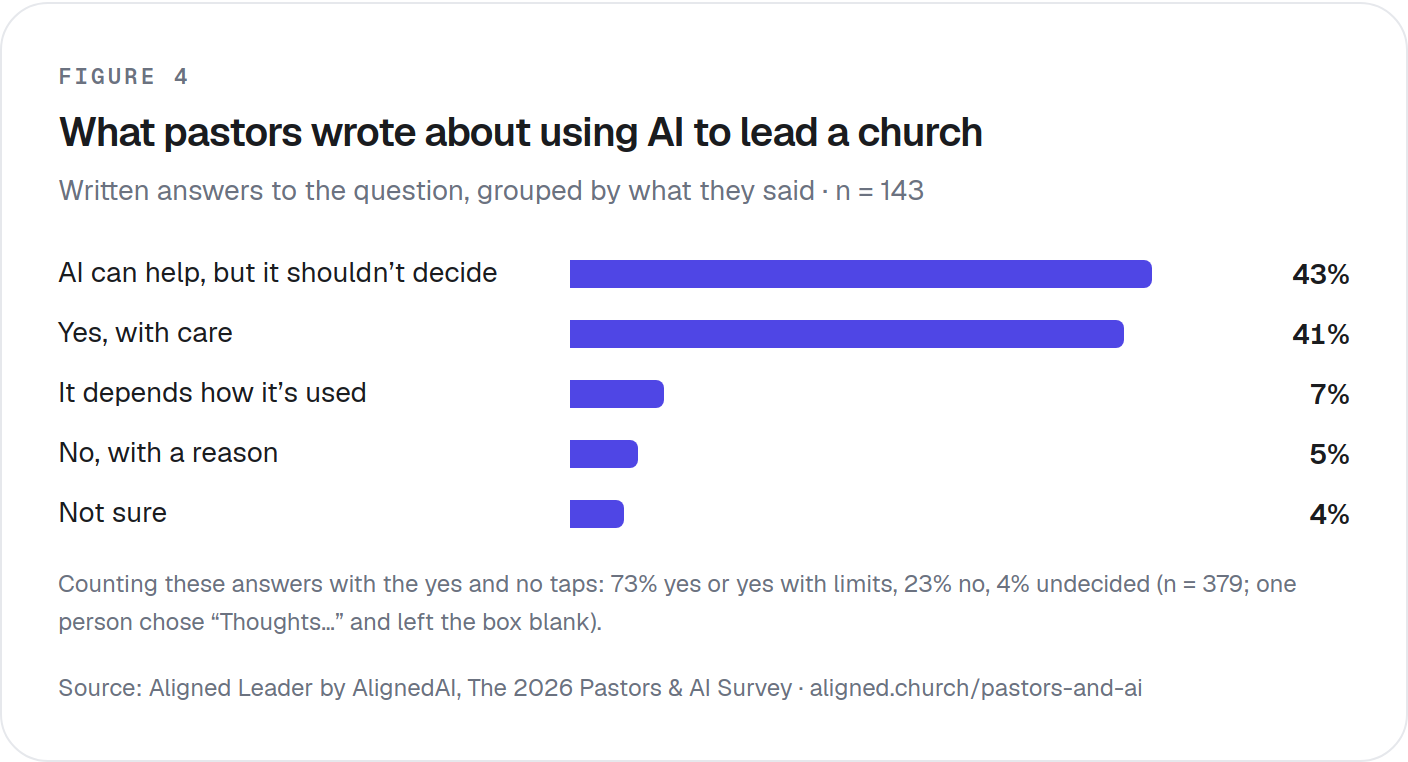
The boundary was the question’s own example: using AI “to understand what their church needs to hear.” Many pastors said that is exactly what AI can’t do. The most common written answer (43%) was that AI can help with research, outlines, wording and administration, but it shouldn’t decide. That comes from prayer, Scripture and knowing your people. Another 41% said yes, with care: verify it, pray, and don’t let it become your main source.
What pastors wrote about using AI to lead a church
Written answers to the question, grouped by what they said · n = 143
What pastors wrote about using AI to lead a church: AI can help, but it shouldn’t decide, 43%; Yes, with care, 41%; It depends how it’s used, 7%; No, with a reason, 5%; Not sure, 4% (n = 143). Source: Aligned Leader by AlignedAI, The 2026 Pastors & AI Survey.
- AI can help, but it shouldn’t decide43%43% · 61 of 143 · AI can help, but it shouldn’t decide
- Yes, with care41%41% · 59 of 143 · Yes, with care
- It depends how it’s used7%7% · 10 of 143 · It depends how it’s used
- No, with a reason5%5% · 7 of 143 · No, with a reason
- Not sure4%4% · 6 of 143 · Not sure
Counting these answers with the yes and no taps: 73% yes or yes with limits, 23% no, 4% undecided (n = 379; one person chose “Thoughts…” and left the box blank).
Show table
| Answer | Share | Answers |
|---|---|---|
| AI can help, but it shouldn’t decide | 43% | 61 |
| Yes, with care | 41% | 59 |
| It depends how it’s used | 7% | 10 |
| No, with a reason | 5% | 7 |
| Not sure | 4% | 6 |
For help, yes. To lead, no.
Some pastors do see a place for AI in understanding a congregation, through data rather than guesswork: analyzing a church survey or demographic information, or helping design the questions to ask (10 written answers).
“Using AI to GET TO answers is much different than using AI to retrieve ‘answers’.”
“I think AI can help us speak what we want to say in a clearer way, but how does AI know what a church needs? We would be losing the relationship part with our people.”
“AI offers perspectives that an individual pastor might not otherwise hear or consider. But AI shouldn’t take the place of reasoned, prayerful pastoral leadership.”
“I like to use it to help with research, because it cuts down on the amount of reading, but then I wrestle whether it is removing the spirit from the work.”
Leaders of non-denominational evangelical churches were the most cautious: 34% said no, compared with 16% of everyone else. Church size made little difference.
How are pastors using AI?
Mostly for research. Of the 115 respondents who described how they use AI, 68% mentioned research or Bible study: background on a passage, summaries of commentaries and scholars, history and word meanings.
Fewer mentioned wording and editing (17%), outlines and organizing their thoughts (16%), administration and planning (10%), brainstorming (9%), and analyzing data such as surveys (8%). Several pastors of small churches said the time AI saves goes back into ministry.
How respondents use AI, in their own words
Respondents who described a use in any written answer · n = 115 · one person can name several
How respondents use AI, in their own words: Research and Bible study, 68%; Wording and editing, 17%; Outlines and organizing thoughts, 16%; Administration and planning, 10%; Brainstorming ideas, 9%; Analyzing data, such as surveys, 8%; Saving time for ministry, 8%; Finding verses, 7%; Sermon preparation, in general, 6%; Other uses, 6% (n = 115). Source: Aligned Leader by AlignedAI, The 2026 Pastors & AI Survey.
- Research and Bible study68%68% · 78 of 115 · Research and Bible study
- Wording and editing17%17% · 20 of 115 · Wording and editing
- Outlines and organizing thoughts16%16% · 18 of 115 · Outlines and organizing thoughts
- Administration and planning10%10% · 11 of 115 · Administration and planning
- Brainstorming ideas9%9% · 10 of 115 · Brainstorming ideas
- Analyzing data, such as surveys8%8% · 9 of 115 · Analyzing data, such as surveys
- Saving time for ministry8%8% · 9 of 115 · Saving time for ministry
- Finding verses7%7% · 8 of 115 · Finding verses
- Sermon preparation, in general6%6% · 7 of 115 · Sermon preparation, in general
- Other uses6%6% · 7 of 115 · Other uses
These are uses people volunteered in open answers, not a usage survey. Other uses: lesson prep, devotionals and posts from sermons, reading plans, and help with dyslexia or explaining ideas.
Show table
| Answer | Share | People |
|---|---|---|
| Research and Bible study | 68% | 78 |
| Wording and editing | 17% | 20 |
| Outlines and organizing thoughts | 16% | 18 |
| Administration and planning | 10% | 11 |
| Brainstorming ideas | 9% | 10 |
| Analyzing data, such as surveys | 8% | 9 |
| Saving time for ministry | 8% | 9 |
| Finding verses | 7% | 8 |
| Sermon preparation, in general | 6% | 7 |
| Other uses | 6% | 7 |
What it does is cut my preparation time in half, so I can spend that time shepherding and caring for the congregation.
“I am a pastor of a small church who works a job. So, I use AI as a tool to help me streamline a lot of things to lead the church.”
“…creating devotionals from a transcript or notes and editing them for content if the Lord leads (especially helpful for me as a bi-vocational pastor who wants to keep the church engaged through the week but has very limited time) is something that is wonderful as a tool. And that’s the key: a tool, not a substitute or replacement.”
“I think it would be improper for me to just say ‘write a sermon on discipleship’ and not be actively writing my thoughts, ideas, and insights down myself.”
How should pastors approach AI? Seven principles from pastors’ answers
Put the answers together and a pastoral approach to AI comes into focus. These seven principles come from what pastors wrote, with the share behind each where we could count it.
- 01
Start with prayer and the text. Ask AI second.
2 Timothy 2:15
AI comes after the spiritual work, never instead of it. Nearly one in five respondents who wrote an answer (18%) mentioned the Holy Spirit, and pastors returned again and again to personal study and prayer.
“AI should never replace a pastor’s time of seeking the Lord or Bible study, but it can be useful for outlines and starter ideas.”
- 02
Use AI to gather, not to discern.
This line ran through the survey. For believers, many put it as “research, yes; guidance, no” (30% of written answers about ChatGPT), and almost as many as “yes, if you check it against Scripture” (31%). For pastors, it was “AI can help, but it shouldn’t decide” (43% of written answers about leading a church), the most common answer to that question.
“AI is not an anointed person.”
- 03
Test every answer against Scripture.
Acts 17:11 · 1 Thessalonians 5:21
A third of respondents who wrote an answer (33%) said to double-check what AI says, most often against the Bible. Three pointed to the Bereans, who “searched the scriptures daily, whether those things were so” (Acts 17:11, KJV).
“If AI is not in agreement with Bible, discard the entire response.”
- 04
Keep the sermon yours.
Pastors who wrote about preaching drew the same line: whatever help AI gives, the message has to come from the pastor’s own study, prayer and voice.
“…the sermon must be written from the heart of the pastor to his congregation.”
- 05
Keep shepherding human.
A third of those who wrote an answer (33%) said, without being asked, that guidance, leadership or care belongs with God and his people, not with AI. A pastor learns what a church needs by being with it.
“Conversation with people in the church should be the way a pastor learns of people’s needs.”
- 06
Guard your people.
Fewer pastors raised it, but those who did were specific: keep personal information out of AI tools, know what children and teens are doing with AI, and don’t trust every image or video. One in six of those who named a danger pointed to privacy, children or deception.
“We should use the most protected AI and with caution never sharing personal information.”
- 07
Teach your church, without fear.
With half of pastors already fielding questions, staying silent leaves people to learn from the algorithm. Pastors asked for honesty about both the benefits and the dangers, in a calm tone.
“We must be cautious, but curious.”
What are the dangers of AI for Christians?
Wrong answers, over-dependence and a worldview that isn’t drawn from Scripture. Of the 91 respondents who named a specific danger, 35% pointed to wrong or misleading answers, 29% to dependence that crowds out personal Bible study, prayer and thinking, and 20% to a worldview shaped by secular or mixed sources.
The dangers pastors named
Respondents who named a specific danger when asked how churches should warn their congregation · n = 91 · one person can name several
The dangers pastors named: Wrong or misleading answers, 35%; Dependence in place of study, prayer and thinking, 29%; A worldview from secular or mixed sources, 20%; Replacing human relationships, 10%; Privacy and personal information, 8%; Treating AI as the final word, 8%; Fabricated images and other deception, 7%; Children’s and teens’ use, 5%; Society: environment, artists’ work, regulation, 5%; Spiritual deception or idolatry, 5%; Telling users what they want to hear, 3% (n = 91). Source: Aligned Leader by AlignedAI, The 2026 Pastors & AI Survey.
- Wrong or misleading answers35%35% · 32 of 91 · Wrong or misleading answers
- Dependence in place of study, prayer and thinking29%29% · 26 of 91 · Dependence in place of study, prayer and thinking
- A worldview from secular or mixed sources20%20% · 18 of 91 · A worldview from secular or mixed sources
- Replacing human relationships10%10% · 9 of 91 · Replacing human relationships
- Privacy and personal information8%8% · 7 of 91 · Privacy and personal information
- Treating AI as the final word8%8% · 7 of 91 · Treating AI as the final word
- Fabricated images and other deception7%7% · 6 of 91 · Fabricated images and other deception
- Children’s and teens’ use5%5% · 5 of 91 · Children’s and teens’ use
- Society: environment, artists’ work, regulation5%5% · 5 of 91 · Society: environment, artists’ work, regulation
- Spiritual deception or idolatry5%5% · 5 of 91 · Spiritual deception or idolatry
- Telling users what they want to hear3%3% · 3 of 91 · Telling users what they want to hear
331 people answered this question in writing; most described what to say rather than naming a danger.
Show table
| Answer | Share | People |
|---|---|---|
| Wrong or misleading answers | 35% | 32 |
| Dependence in place of study, prayer and thinking | 29% | 26 |
| A worldview from secular or mixed sources | 20% | 18 |
| Replacing human relationships | 10% | 9 |
| Privacy and personal information | 8% | 7 |
| Treating AI as the final word | 8% | 7 |
| Fabricated images and other deception | 7% | 6 |
| Children’s and teens’ use | 5% | 5 |
| Society: environment, artists’ work, regulation | 5% | 5 |
| Spiritual deception or idolatry | 5% | 5 |
| Telling users what they want to hear | 3% | 3 |
Advise the congregation that AI will get you the wrong answer faster.
“Since LLMs are trained on everything, they will of necessity be reflections of secular society rather than Biblical principles. This can be extremely subtle…”
“If AI is your immediate go-to for information you take away the struggle in Bible study and prayer to receive a word from God.”
“Some turn to AI to share their deep truths and questions without fear of judgement… There’s no ‘checks and balances’ with AI, i.e., accountability, human compassion or connection to the wisdom of the Holy Spirit.”
“Do parents know about their kids’ AI use and/or habits?”
How should churches talk to their congregation about AI?
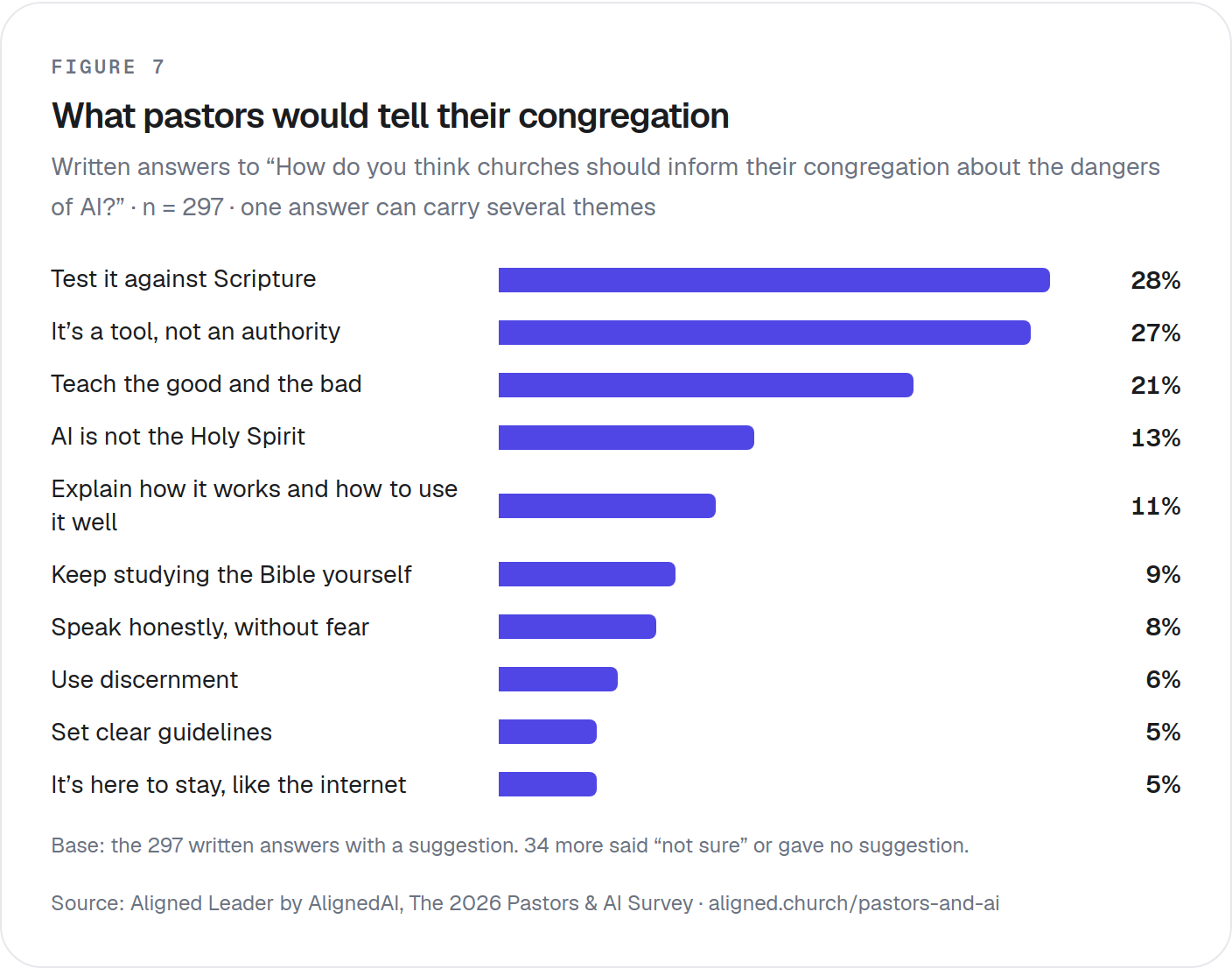
From Scripture, honestly, and without fear. The most common advice was to teach people to test AI against the Bible (28% of answers), to treat it as a tool rather than an authority (27%), and to be open about both the good and the bad (21%).
What pastors would tell their congregation
Written answers to “How do you think churches should inform their congregation about the dangers of AI?” · n = 297 · one answer can carry several themes
What pastors would tell their congregation: Test it against Scripture, 28%; It’s a tool, not an authority, 27%; Teach the good and the bad, 21%; AI is not the Holy Spirit, 13%; Explain how it works and how to use it well, 11%; Keep studying the Bible yourself, 9%; Speak honestly, without fear, 8%; Use discernment, 6%; Set clear guidelines, 5%; It’s here to stay, like the internet, 5% (n = 297). Source: Aligned Leader by AlignedAI, The 2026 Pastors & AI Survey.
- Test it against Scripture28%28% · 83 of 297 · Test it against Scripture
- It’s a tool, not an authority27%27% · 80 of 297 · It’s a tool, not an authority
- Teach the good and the bad21%21% · 61 of 297 · Teach the good and the bad
- AI is not the Holy Spirit13%13% · 39 of 297 · AI is not the Holy Spirit
- Explain how it works and how to use it well11%11% · 32 of 297 · Explain how it works and how to use it well
- Keep studying the Bible yourself9%9% · 26 of 297 · Keep studying the Bible yourself
- Speak honestly, without fear8%8% · 25 of 297 · Speak honestly, without fear
- Use discernment6%6% · 17 of 297 · Use discernment
- Set clear guidelines5%5% · 15 of 297 · Set clear guidelines
- It’s here to stay, like the internet5%5% · 15 of 297 · It’s here to stay, like the internet
Base: the 297 written answers with a suggestion. 34 more said “not sure” or gave no suggestion.
Show table
| Answer | Share | Answers |
|---|---|---|
| Test it against Scripture | 28% | 83 |
| It’s a tool, not an authority | 27% | 80 |
| Teach the good and the bad | 21% | 61 |
| AI is not the Holy Spirit | 13% | 39 |
| Explain how it works and how to use it well | 11% | 32 |
| Keep studying the Bible yourself | 9% | 26 |
| Speak honestly, without fear | 8% | 25 |
| Use discernment | 6% | 17 |
| Set clear guidelines | 5% | 15 |
| It’s here to stay, like the internet | 5% | 15 |
Where pastors would teach it
Answers that named a setting · n = 69 · one answer can name several
Where pastors would teach it: From the pulpit, 39%; Small groups, Bible studies and classes, 29%; Open conversation and Q&A, 26%; A workshop, seminar or town hall, 17%; Newsletters, bulletins and handouts, 13%; Regularly, as an ongoing topic, 12%; Through teaching, setting unspecified, 10%; Only when asked or when the text raises it, 7% (n = 69). Source: Aligned Leader by AlignedAI, The 2026 Pastors & AI Survey.
- From the pulpit39%39% · 27 of 69 · From the pulpit
- Small groups, Bible studies and classes29%29% · 20 of 69 · Small groups, Bible studies and classes
- Open conversation and Q&A26%26% · 18 of 69 · Open conversation and Q&A
- A workshop, seminar or town hall17%17% · 12 of 69 · A workshop, seminar or town hall
- Newsletters, bulletins and handouts13%13% · 9 of 69 · Newsletters, bulletins and handouts
- Regularly, as an ongoing topic12%12% · 8 of 69 · Regularly, as an ongoing topic
- Through teaching, setting unspecified10%10% · 7 of 69 · Through teaching, setting unspecified
- Only when asked or when the text raises it7%7% · 5 of 69 · Only when asked or when the text raises it
Small groups include Sunday school.
Show table
| Answer | Share | Answers |
|---|---|---|
| From the pulpit | 39% | 27 |
| Small groups, Bible studies and classes | 29% | 20 |
| Open conversation and Q&A | 26% | 18 |
| A workshop, seminar or town hall | 17% | 12 |
| Newsletters, bulletins and handouts | 13% | 9 |
| Regularly, as an ongoing topic | 12% | 8 |
| Through teaching, setting unspecified | 10% | 7 |
| Only when asked or when the text raises it | 7% | 5 |
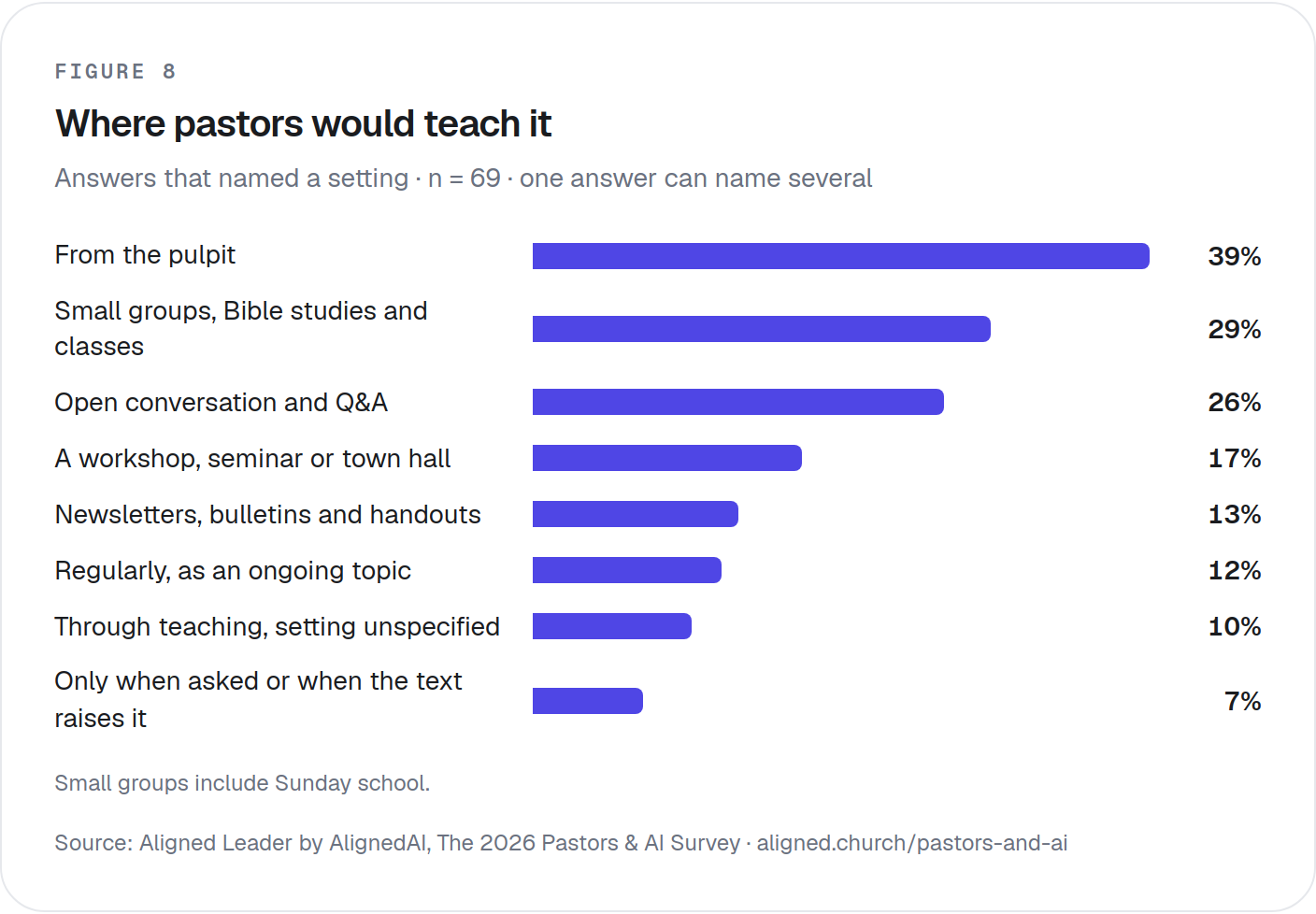
Some would start by listening. One lead pastor suggested asking from the pulpit whether anyone has concerns about AI, then following up with a questionnaire. Others would give it time outside the Sunday sermon, “like we might with finances, online security.” A few would address it only when asked, or “only when it is relevant to the text as you teach through the whole Bible, verse by verse.”
A talk outline, from pastors’ own words
Six things to tell your congregation about AI
- 1
AI is a tool. It isn’t good or evil in itself; what matters is how we use it.
“Like a chainsaw, when used correctly, it can cut down a tree. In the hands of an artist, it can sculpt a beautiful object. Yet in the hands of a novice can cause injury or death.”
- 2
It’s a resource, not the source. Scripture is our authority, and AI can be confidently wrong.
“AI can be a resource but it is in no way the source.”
- 3
Be a Berean. Check every answer against the Bible before you believe it.
“Do what the Bereans did. They checked the scriptures.”
- 4
AI isn’t the Holy Spirit, and it isn’t your pastor. Bring your real questions to God and to people who know you.
- 5
Don’t outsource your soul. Keep reading, praying and thinking for yourself.
“Christians should be advised to remain the gatekeepers of their spiritual world.”
- 6
Guard your home. Keep personal details out of AI tools, know what your kids are using, and don’t believe every image you see.
Close with the line one pastor offered: “Cautious, but curious.”
Churches should teach members to use AI as a servant, not a master.
“Instead of focusing on fear, pastors should emphasize responsible use: verifying information, protecting privacy, avoiding deception, and using AI to serve others rather than manipulate or deceive.”
Where pastors disagree
Not every pastor sees a place for AI. 21% said it isn’t ethical for pastors to use AI to help lead their church, and 38% said Christians shouldn’t use ChatGPT or Claude for spiritual guidance.
A few would steer their people away from AI altogether. At the other end, some see little danger and use it every day. A smaller group (8% of written answers about ChatGPT) would point believers to AI built on Christian sources instead of general tools, and some would teach on AI only when asked.
What the answers share, even among pastors who use AI every week, is the order of authority: Scripture, prayer and people first, and AI, if at all, beneath them.
“It is not about the tool, but it is about the heart.”
“ChatGPT will give knowledge answers, but not those influenced by a Biblical worldview.”
Differences by church size and tradition
Church size shapes how often the question comes up, not how pastors answer it.
Leaders of larger churches are more likely to have been asked about AI. Views on ChatGPT and on pastors’ own use were similar across church sizes. By tradition, two differences stand out: leaders in the Pentecostal / Charismatic tradition are more likely than others to have been asked, and non-denominational evangelical leaders are the most likely to say pastors shouldn’t use AI to help lead.
| Church size | Asked | ChatGPT: yes | ChatGPT: no | Pastors’ AI use: yes | Pastors’ AI use: no |
|---|---|---|---|---|---|
| Under 100 people | 47% | 16% | 36% | 42% | 20% |
| 100–249 people | 58% | 15% | 41% | 43% | 25% |
| 250 or more | 63% | 6% | 43% | 32% | 22% |
| All respondents | 51% | 14% | 38% | 41% | 21% |
| Tradition | n | Asked | ChatGPT: yes | ChatGPT: no | Pastors’ AI use: yes | Pastors’ AI use: no |
|---|---|---|---|---|---|---|
| Non-Denominational Evangelical | 118 | 53% | 10% | 46% | 32% | 34% |
| Conservative Evangelical / Baptist | 101 | 47% | 16% | 29% | 49% | 13% |
| Pentecostal / Charismatic | 73 | 63% | 20% | 43% | 38% | 25% |
| Methodist / Wesleyan / Holiness | 34 | 35% | 13% | 41% | 31% | 13% |
| Reformed Baptist | 21 | 33% | 16% | 32% | 47% | 16% |
| Assemblies of God / Pentecostal | 19 | 32% | 6% | 25% | 38% | 13% |
| Churches of Christ / Restoration | 16 | 69% | 13% | 20% | 73% | 7% |
| Eight other traditions | 35 | 57% | 15% | 38% | 44% | 18% |
Questions pastors ask about AI
Should pastors use AI?
Most pastors in the Aligned Leader 2026 Pastors & AI Survey (by AlignedAI) see a faithful way to use it: 73% of 379 pastors and church leaders said there is an ethical way for pastors to use AI in leading their church. The most common condition was that AI helps with research, outlines, wording and administration, while prayer, Scripture and knowing the congregation decide what the church needs to hear. About one in four (23%) said pastors shouldn’t use AI this way.
Should Christians use ChatGPT for spiritual guidance?
Most pastors say no, or not without conditions. Only 14% said Christians should use generic AI platforms like ChatGPT and Claude for spiritual guidance, 38% said no, and 48% answered in their own words. The most common written views were that AI is fine if every answer is checked against Scripture, and that it suits research and Bible study but not spiritual guidance.
Is it wrong for pastors to use AI to write sermons?
The pastors in the survey who wrote about sermons drew a consistent line: the sermon should come from the pastor’s own study, prayer and voice. As one put it, “the sermon must be written from the heart of the pastor to his congregation.”
What are the dangers of AI for Christians?
Pastors most often named wrong or misleading answers (35% of those who named a danger), dependence on AI in place of personal Bible study, prayer and thinking (29%), and a worldview drawn from secular sources rather than Scripture (20%). Others raised replacing human relationships, privacy, fabricated images and other deception, and children’s use of AI.
How should a church talk to its congregation about AI?
Pastors recommend teaching it from Scripture and without fear: tell people to test AI’s answers against the Bible, treat AI as a tool rather than an authority, and be honest about both its benefits and its dangers. The settings they suggested most were the pulpit, small groups and classes, and open conversation.
Will AI replace pastors?
Not according to the pastors we surveyed. A third of those who wrote an answer (33%) said, without being asked, that guidance, leadership and care belong with God and his people, not with AI. “Asking AI for spiritual guidance is replacing the pastor with a computer,” one lead pastor wrote.
Are church members asking pastors about AI?
Yes. 51% of pastors and church leaders said congregants have asked them how to approach AI as a believer (189 of 414 occasionally and 23 often). The share rises with church size, from 47% at churches under 100 people to 60% at churches of 100 or more.
Who conducted this survey?
Aligned Leader by AlignedAI surveyed 420 pastors and church leaders who use Aligned Leader and Aligned Church, between October 5 and 26, 2026. Answers are anonymous; quotes in this report carry only a role and a church size. The report was written by Jonathan Bodnar, founder of AlignedAI.
About this survey
Who we asked. Pastors and church leaders with Aligned Leader and Aligned Church accounts. The survey opened inside Aligned Leader and Aligned Church on a leader’s next visit, never on the day they signed up, and an email invitation went to 4,829 leaders on October 6, 2026. 1,868 leaders saw it in the app.
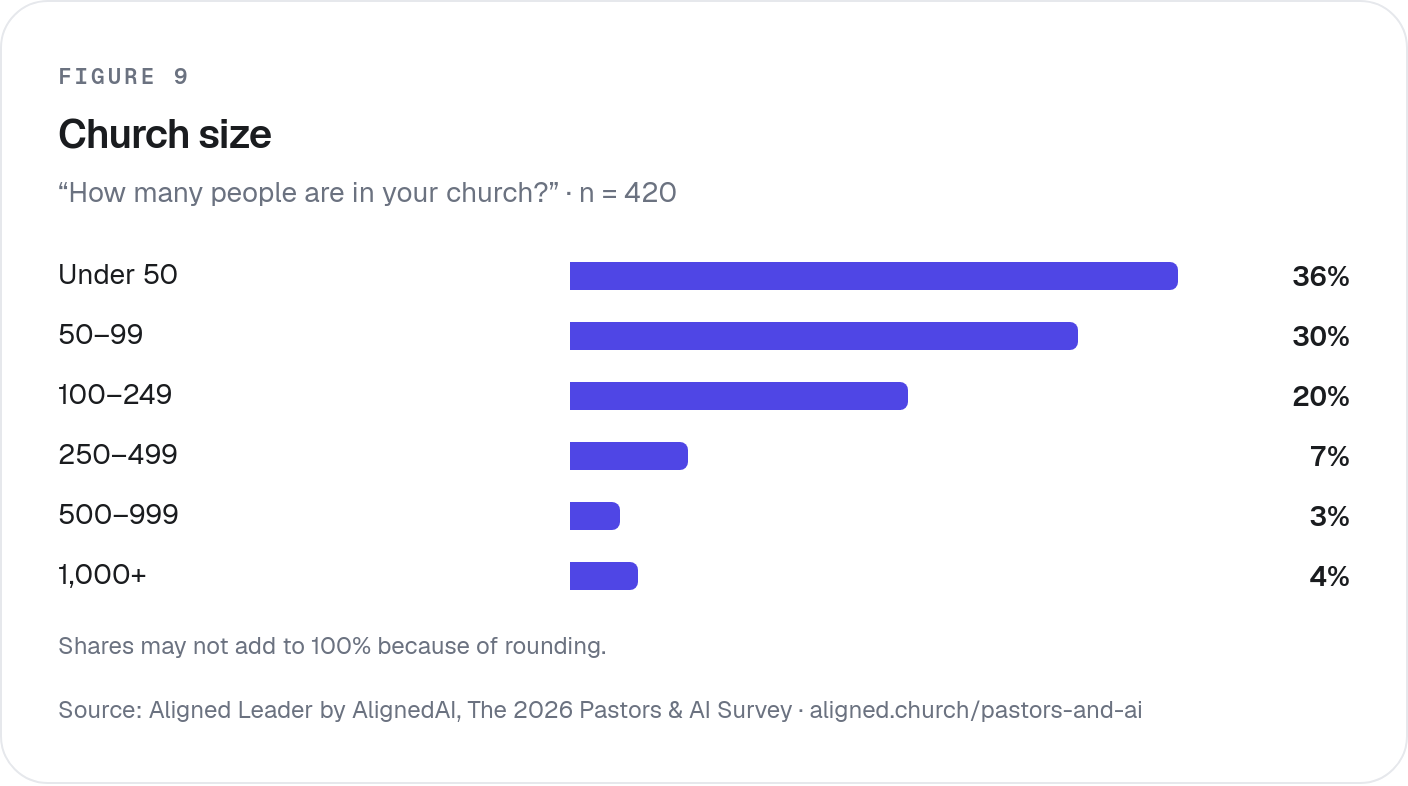
Who answered. 420 people answered at least one question, and 378 answered all four multiple-choice questions; 331 wrote an answer to the one open question (Question 3, which was optional). 417 of their churches are in the United States; the other three didn’t list a country. Two-thirds lead churches of fewer than 100 people. Of the 165 who listed a role, 76% are pastors, including 63% who are lead pastors.
Church size
“How many people are in your church?” · n = 420
Church size: Under 50, 36%; 50–99, 30%; 100–249, 20%; 250–499, 7%; 500–999, 3%; 1,000+, 4% (n = 420). Source: Aligned Leader by AlignedAI, The 2026 Pastors & AI Survey.
- Under 5036%36% · 151 of 420 · Under 50
- 50–9930%30% · 126 of 420 · 50–99
- 100–24920%20% · 84 of 420 · 100–249
- 250–4997%7% · 31 of 420 · 250–499
- 500–9993%3% · 12 of 420 · 500–999
- 1,000+4%4% · 16 of 420 · 1,000+
Shares may not add to 100% because of rounding.
Show table
| Church size | Share | Respondents |
|---|---|---|
| Under 50 | 36% | 151 |
| 50–99 | 30% | 126 |
| 100–249 | 20% | 84 |
| 250–499 | 7% | 31 |
| 500–999 | 3% | 12 |
| 1,000+ | 4% | 16 |
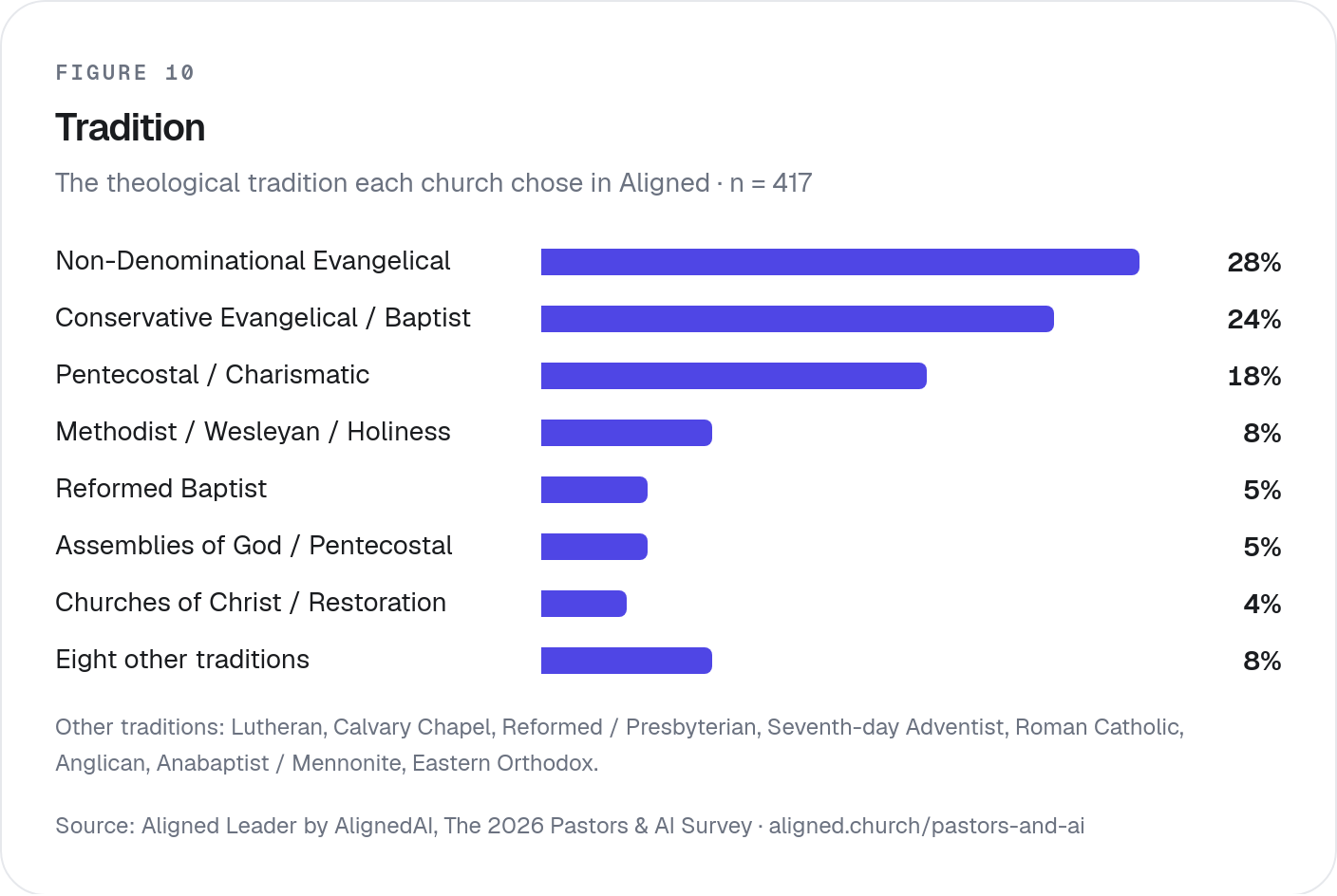
Tradition
The theological tradition each church chose in Aligned · n = 417
Tradition: Non-Denominational Evangelical, 28%; Conservative Evangelical / Baptist, 24%; Pentecostal / Charismatic, 18%; Methodist / Wesleyan / Holiness, 8%; Reformed Baptist, 5%; Assemblies of God / Pentecostal, 5%; Churches of Christ / Restoration, 4%; Eight other traditions, 8% (n = 417). Source: Aligned Leader by AlignedAI, The 2026 Pastors & AI Survey.
- Non-Denominational Evangelical28%28% · 118 of 417 · Non-Denominational Evangelical
- Conservative Evangelical / Baptist24%24% · 101 of 417 · Conservative Evangelical / Baptist
- Pentecostal / Charismatic18%18% · 73 of 417 · Pentecostal / Charismatic
- Methodist / Wesleyan / Holiness8%8% · 34 of 417 · Methodist / Wesleyan / Holiness
- Reformed Baptist5%5% · 21 of 417 · Reformed Baptist
- Assemblies of God / Pentecostal5%5% · 19 of 417 · Assemblies of God / Pentecostal
- Churches of Christ / Restoration4%4% · 16 of 417 · Churches of Christ / Restoration
- Eight other traditions8%8% · 35 of 417 · Eight other traditions
Other traditions: Lutheran, Calvary Chapel, Reformed / Presbyterian, Seventh-day Adventist, Roman Catholic, Anglican, Anabaptist / Mennonite, Eastern Orthodox.
Show table
| Answer | Share | Respondents |
|---|---|---|
| Non-Denominational Evangelical | 28% | 118 |
| Conservative Evangelical / Baptist | 24% | 101 |
| Pentecostal / Charismatic | 18% | 73 |
| Methodist / Wesleyan / Holiness | 8% | 34 |
| Reformed Baptist | 5% | 21 |
| Assemblies of God / Pentecostal | 5% | 19 |
| Churches of Christ / Restoration | 4% | 16 |
| Eight other traditions | 8% | 35 |
When. October 5–26, 2026. Results reflect answers as of October 26, 2026.
The questions. In order, as respondents saw them:
- How many people are in your church? Under 50 · 50–99 · 100–249 · 250–499 · 500–999 · 1,000+
- Have congregants asked how to approach AI as a believer? Never · Occasionally · Often
- How do you think churches should inform their congregation about the dangers of AI? Written answer, optional
- Do you think Christians should use generic AI platforms like ChatGPT and Claude for spiritual guidance? Yes · No · Thoughts… (written answer)
- Is it ethical for pastors to use AI to help lead their church, for example using AI to understand what their church needs to hear? Yes · No · Thoughts… (written answer)
How we counted. Percentages are of the people who answered each question, so bases differ and are shown as n. Percentages are rounded and may not add to 100. We read every written answer and grouped it by theme; one answer can carry several themes, except in Figures 3 and 4, where each answer is counted once by its main point. Differences we call out between groups are statistically significant (p < .05, chi-square or Fisher’s exact test); the others are not.
Things to keep in mind. Respondents chose to take part and already use an AI tool in ministry, so they may be more open to AI than pastors overall. The results are not weighted. Questions 3 and 4 were shown with short facts about how people use AI, which may have encouraged caution. The one above Question 4 said generic AI platforms can misquote the Bible up to 60% of the time. That figure traces to YouVersion’s CEO, Bobby Gruenewald, who said the best AI model misquotes Scripture at least 15% of the time and some models as much as 60%; he did not say which models were tested or how errors were counted. Question 4 was a written-only question for its first day; those 35 answers are counted with “Thoughts…”.
Anonymity. The survey promised that answers would be anonymized and names never mentioned. Quotes carry only a role and a church size, and are lightly edited for spelling and punctuation.
Outside sources. The “For context” notes and the fact above Question 4 come from the research below. We checked each figure against its source on October 26, 2026.
- Barna Group, AI is Becoming a Spiritual Authority, Even Among Practicing Christians, May 19, 2026; 1,514 U.S. adults (November 2025) and 442 U.S. Protestant pastors (December 2025).
- Barna Group, New Research: Pastors Are Using AI More Than You Think, June 15, 2026; 442 U.S. Protestant pastors (December 2025).
- Lifeway Research, Pastors, Churchgoers See AI as Concerning and Confusing, April 21, 2026; 1,200 U.S. Protestant churchgoers (September 2–7, 2025).
- Christian Daily International, AI’s Scripture problem: misquotes range from 15% to 60%, says YouVersion CEO, March 16, 2026; an interview with Bobby Gruenewald.
Author
Jonathan Bodnar, founder of AlignedAI. He built and exited a church management and giving platform before founding AlignedAI.
Prepared with the Aligned Leader team.
About Aligned Leader and AlignedAI
AlignedAI makes AI tools for pastors and churches: Aligned Leader, a free AI sermon writer and Bible study assistant for pastors, and Aligned Church, AI church management. Read how we approach AI in our guardrails, and see What is Christian AI? for how faith-based AI differs from general tools.
Cite this report
Aligned Leader by AlignedAI. “How Pastors Are Approaching AI: The 2026 Pastors & AI Survey.” Survey of 420 pastors and church leaders, October 5–26, 2026. aligned.church/pastors-and-ai.