The 2026 guide
AI for Pastors: Should You Use It, and How (2026 Guide)
Save hours on study and writing for prayer and your people, with every sermon still in your own words and voice.

Read the transcript
Yes: used wisely, AI for pastors is a research and writing assistant for background study, word studies, outlines, emails and admin, ideally one made for pastors, like Aligned Leader, that starts from your own tradition and sermons. In our 2026 Pastors & AI Survey of 420 pastors and church leaders who use AI, 73% saw an ethical way for pastors to use it, most with limits, and 23% said no. Check its work, keep private pastoral matters out of it and never let it replace prayer, your own Bible study or a sermon in your own words and voice.
By Jonathan Bodnar, founder of AlignedAI · Updated November 5, 2026
Key facts
- In Aligned Leader's 2026 Pastors & AI Survey of 420 pastors and church leaders who use AI in ministry (October 2026), 73% said there is an ethical way for pastors to use AI to help lead a church, most with limits; 23% said no. Aligned Leader, “How Pastors Are Approaching AI: The 2026 Pastors & AI Survey” (October 26, 2026)
- 51% of the pastors and church leaders in the 2026 Pastors & AI Survey said congregants have asked them how to approach AI as a believer, rising to 60% at churches of 100 or more people. Aligned Leader, “How Pastors Are Approaching AI: The 2026 Pastors & AI Survey” (October 26, 2026)
- Only 14% of the pastors and church leaders in the 2026 Pastors & AI Survey said Christians should use generic AI platforms like ChatGPT and Claude for spiritual guidance; 38% said no. Aligned Leader, “How Pastors Are Approaching AI: The 2026 Pastors & AI Survey” (October 26, 2026)
- In Lifeway Research's phone survey of 1,003 U.S. Protestant pastors (September 2025), 10% said they are regular users of AI and 32% are experimenting with it, while 18% are intentionally avoiding it and 20% are ignoring it. Lifeway Research, “Pastors, Churchgoers See AI as Concerning and Confusing” (April 21, 2026)
- 94% of the pastors in Barna's December 2025 survey said they are concerned about AI misinterpreting Scripture. Barna Group, “How AI Is Shaping Bible Interpretation” (August 25, 2026)
- Among 1,200 U.S. Protestant churchgoers Lifeway surveyed online (September 2025), 44% see nothing wrong with pastors using AI in sermon prep, 43% disagree (24% strongly) and 13% aren't sure. Lifeway Research, “Pastors, Churchgoers See AI as Concerning and Confusing” (April 21, 2026)
Your people are already asking AI
Whether or not you use it, the people you serve are taking their questions to AI.
- 2.5 billion messages a day: people send ChatGPT more than 2.5 billion messages a day (OpenAI), and over 1.2 billion use it every week (Fortune).
- Parenting: 81% of U.S. parents of children 17 and under have used AI to help with parenting tasks (Lurie Children's).
- Faith: roughly four in ten practicing Christians say AI has helped them with prayer, Bible study or spiritual growth (Barna).
- Trust: 30% of U.S. adults say spiritual advice from AI is just as trustworthy as advice from a pastor (Barna).
- Politics: 27% of Americans ages 18 to 29 used AI chatbots to get political information at least once in the past week (Washington University in St. Louis).
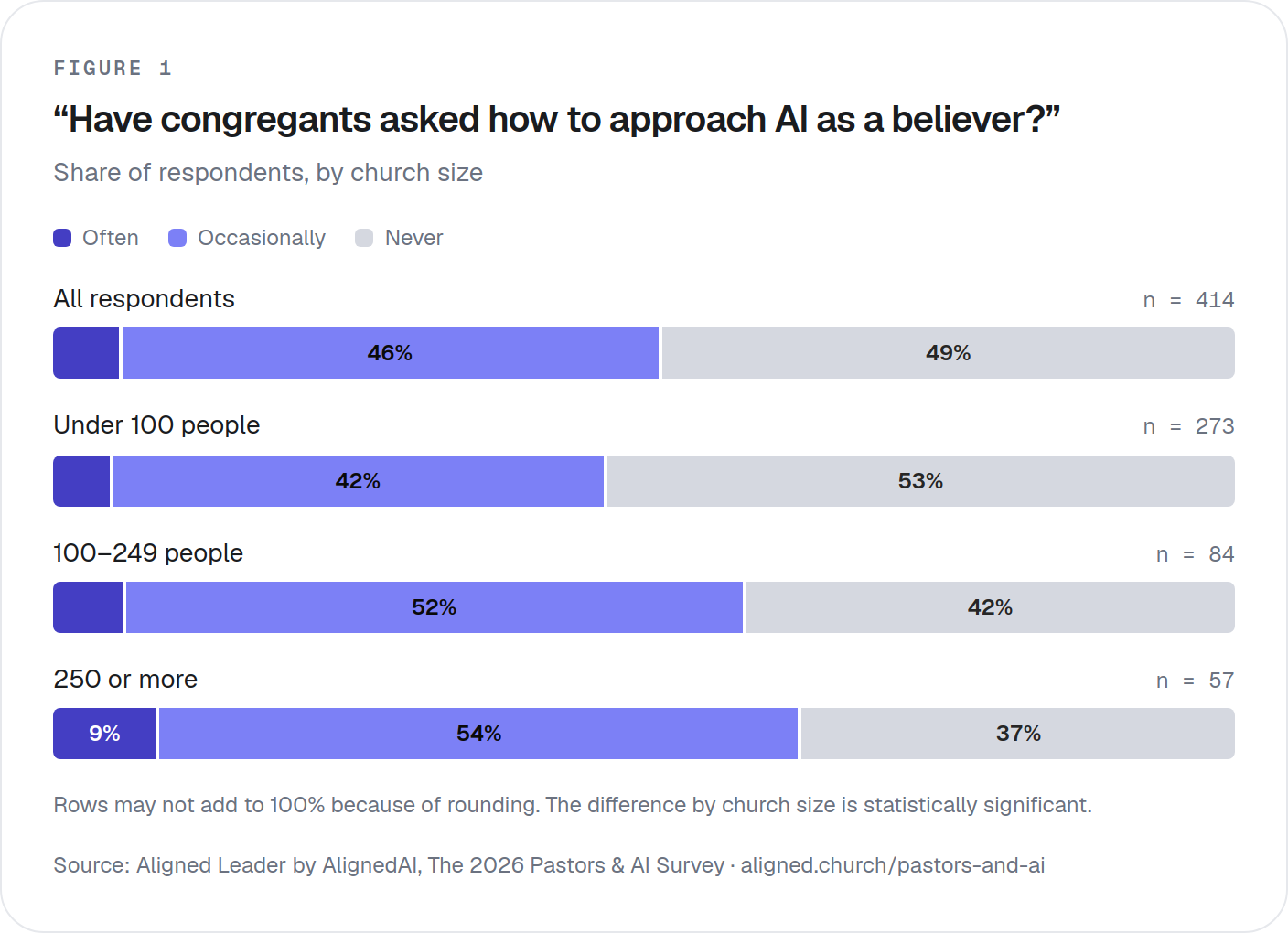
And they're bringing those questions to you. In our 2026 Pastors & AI Survey, half of pastors and church leaders (51%) said congregants have asked them how to approach AI as a believer. The bigger the church, the more often it comes up: 47% at churches under 100 people, and 60% at churches of 100 or more.
“Have congregants asked how to approach AI as a believer?”
Share of respondents, by church size
Have congregants asked how to approach AI as a believer?: All respondents: Often 6%, Occasionally 46%, Never 49% (n = 414); Under 100 people: Often 5%, Occasionally 42%, Never 53% (n = 273); 100–249 people: Often 6%, Occasionally 52%, Never 42% (n = 84); 250 or more: Often 9%, Occasionally 54%, Never 37% (n = 57). Source: The 2026 Pastors & AI Survey.
- Often
- Occasionally
- Never
All respondentsn = 414
6% · Often · 23 of 41446% · Occasionally · 189 of 41449% · Never · 202 of 414Under 100 peoplen = 273
5% · Often · 13 of 27342% · Occasionally · 114 of 27353% · Never · 146 of 273100–249 peoplen = 84
6% · Often · 5 of 8452% · Occasionally · 44 of 8442% · Never · 35 of 84250 or moren = 57
9% · Often · 5 of 5754% · Occasionally · 31 of 5737% · Never · 21 of 57
Rows may not add to 100% because of rounding. The difference by church size is statistically significant.
Show table
| Often | Occasionally | Never | n | |
|---|---|---|---|---|
| All respondents | 6% | 46% | 49% | 414 |
| Under 100 people | 5% | 42% | 53% | 273 |
| 100–249 people | 6% | 52% | 42% | 84 |
| 250 or more | 9% | 54% | 37% | 57 |
“Dealing with AI is going to be a discipleship issue in the life of the church.”
It's time the church answers these questions, not ChatGPT.
How pastors use AI in 2026
Most pastors are curious, careful and still deciding, and surveys disagree on how many use AI, partly because they ask differently. What they use it for is clearer. In Barna's survey the top uses were brainstorming (50%), graphic design (37%), researching biblical or theological topics (36%), and small-group materials and administrative tasks (34% each); writing or editing sermons came lower, at 24%.
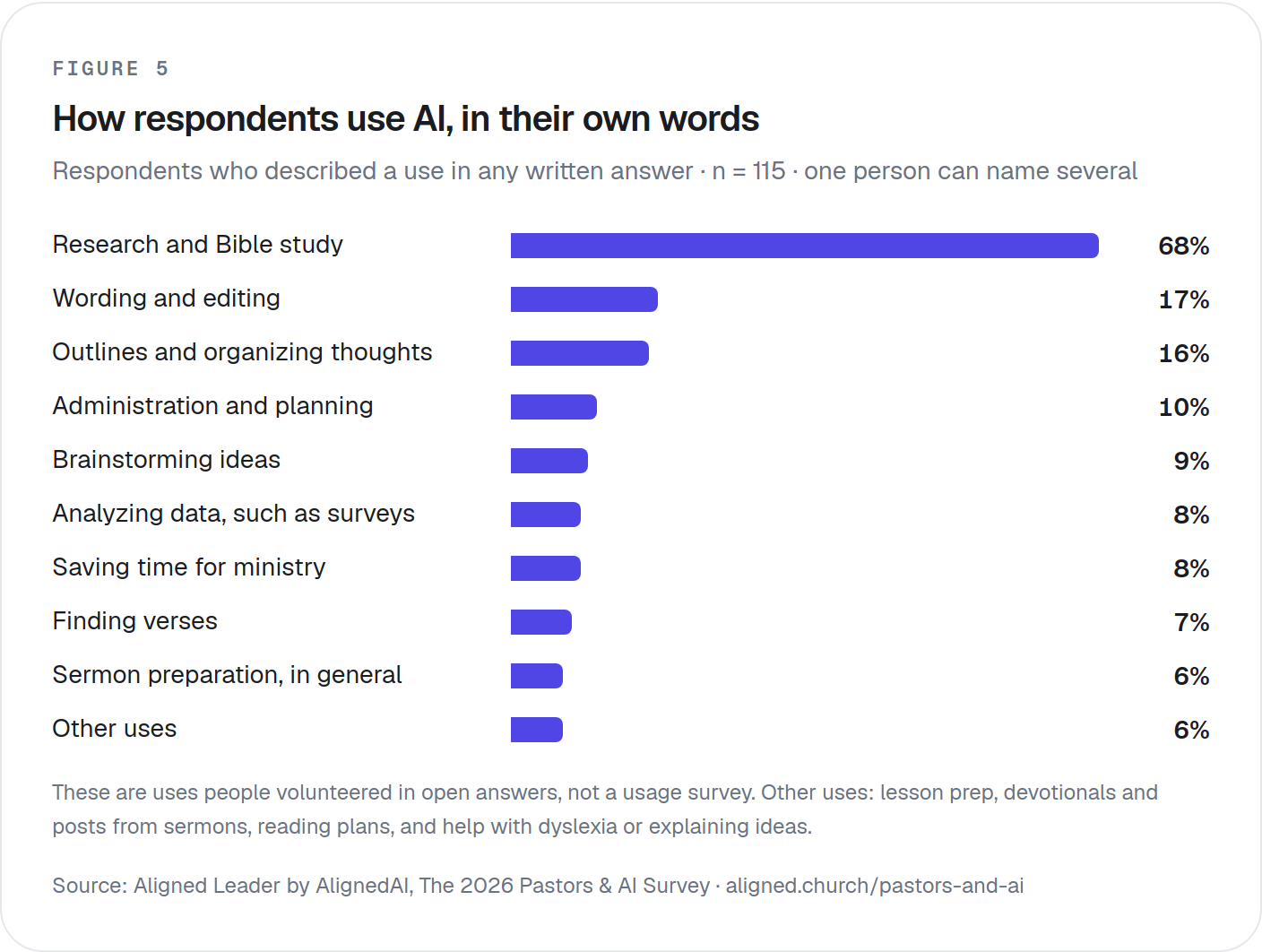
Our survey points the same way. Of the 115 pastors and church leaders who described in their own words how they use AI, 68% named research and Bible study: background on a passage, summaries of commentaries, history and word meanings. Far fewer named wording and editing (17%), outlines (16%) or administration (10%).
How respondents use AI, in their own words
Respondents who described a use in any written answer · n = 115 · one person can name several
How respondents use AI, in their own words: Research and Bible study, 68%; Wording and editing, 17%; Outlines and organizing thoughts, 16%; Administration and planning, 10%; Brainstorming ideas, 9%; Analyzing data, such as surveys, 8%; Saving time for ministry, 8%; Finding verses, 7%; Sermon preparation, in general, 6%; Other uses, 6% (n = 115). Source: The 2026 Pastors & AI Survey.
- Research and Bible study68%68% · 78 of 115 · Research and Bible study
- Wording and editing17%17% · 20 of 115 · Wording and editing
- Outlines and organizing thoughts16%16% · 18 of 115 · Outlines and organizing thoughts
- Administration and planning10%10% · 11 of 115 · Administration and planning
- Brainstorming ideas9%9% · 10 of 115 · Brainstorming ideas
- Analyzing data, such as surveys8%8% · 9 of 115 · Analyzing data, such as surveys
- Saving time for ministry8%8% · 9 of 115 · Saving time for ministry
- Finding verses7%7% · 8 of 115 · Finding verses
- Sermon preparation, in general6%6% · 7 of 115 · Sermon preparation, in general
- Other uses6%6% · 7 of 115 · Other uses
These are uses people volunteered in open answers, not a usage survey. Other uses: lesson prep, devotionals and posts from sermons, reading plans, and help with dyslexia or explaining ideas.
Show table
| Answer | Share | People |
|---|---|---|
| Research and Bible study | 68% | 78 |
| Wording and editing | 17% | 20 |
| Outlines and organizing thoughts | 16% | 18 |
| Administration and planning | 10% | 11 |
| Brainstorming ideas | 9% | 10 |
| Analyzing data, such as surveys | 8% | 9 |
| Saving time for ministry | 8% | 9 |
| Finding verses | 7% | 8 |
| Sermon preparation, in general | 6% | 7 |
| Other uses | 6% | 7 |
“What it does is cut my preparation time in half, so I can spend that time shepherding and caring for the congregation.”
Most pastors start with tasks around the sermon, and fewer use it to help write the sermon itself.
Is it okay for pastors to use AI? What 420 pastors said
Our 2026 Pastors & AI Survey asked 420 pastors and church leaders in October 2026. All of them already use an AI tool in ministry and chose to take part, so read their answers as what AI-using pastors think, not as every pastor's view.
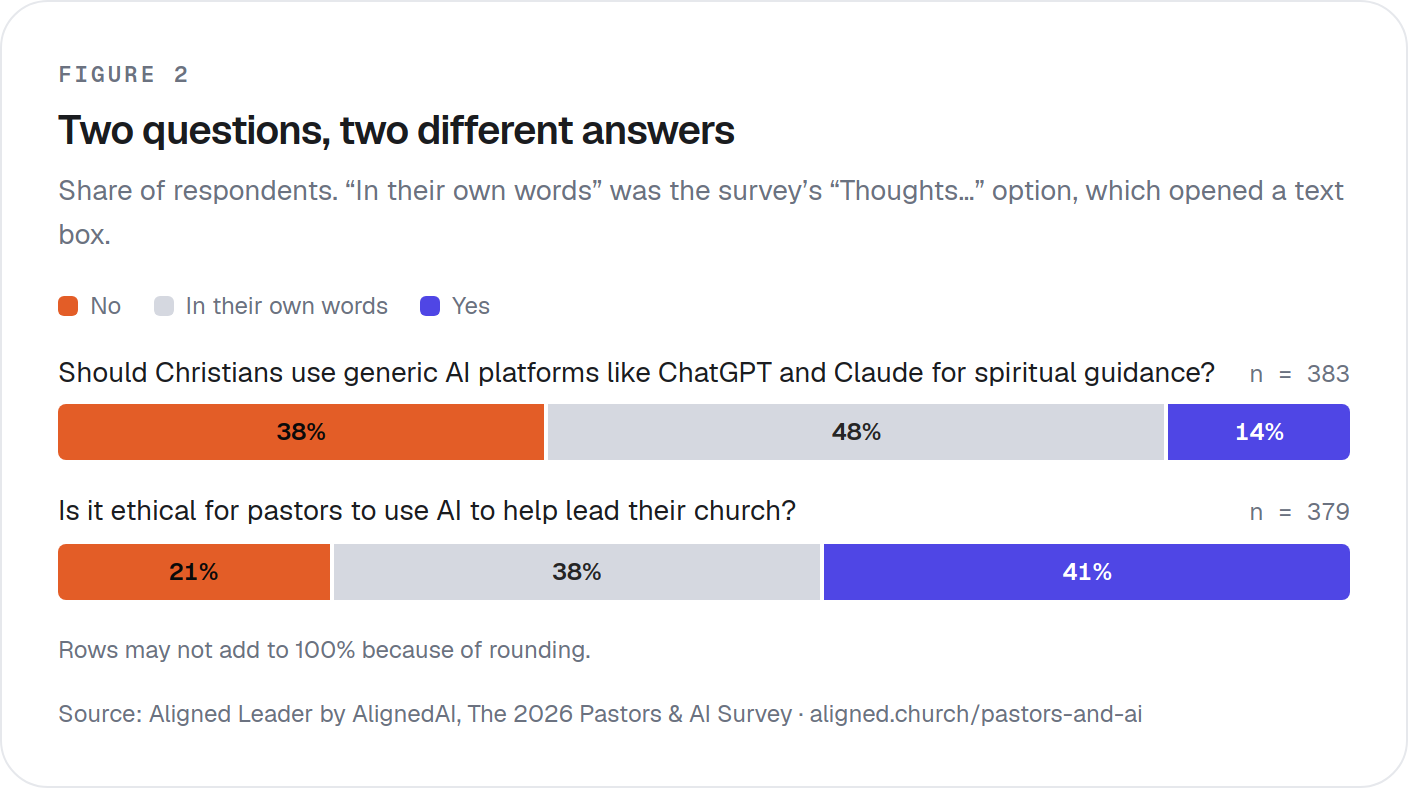
Most see a faithful way to use it. 41% said it's ethical for pastors to use AI to help lead their church, and most of those who answered in their own words described an ethical way too, usually with a limit: 73% in all. About one in four (23%) said no.
The limit they named most was that AI can help, but it shouldn't decide what a church needs to hear (43% of written answers). That comes from prayer, Scripture and knowing your people.
They were warier of AI as a spiritual guide for their people. Only 14% said Christians should use generic AI platforms like ChatGPT and Claude for spiritual guidance, and 38% said no. The most common written answers were "yes, if you check it against Scripture" (31%) and "for research and study, not for guidance" (30%).
Two questions, two different answers
Share of respondents. “In their own words” was the survey’s “Thoughts…” option, which opened a text box.
Two questions, two different answers: Should Christians use generic AI platforms like ChatGPT and Claude for spiritual guidance?: No 38%, In their own words 48%, Yes 14% (n = 383); Is it ethical for pastors to use AI to help lead their church?: No 21%, In their own words 38%, Yes 41% (n = 379). Source: The 2026 Pastors & AI Survey.
- No
- In their own words
- Yes
Should Christians use generic AI platforms like ChatGPT and Claude for spiritual guidance?n = 383
38% · No · 145 of 38348% · In their own words · 184 of 38314% · Yes · 54 of 383Is it ethical for pastors to use AI to help lead their church?n = 379
21% · No · 80 of 37938% · In their own words · 144 of 37941% · Yes · 155 of 379
Rows may not add to 100% because of rounding.
Show table
| No | In their own words | Yes | n | |
|---|---|---|---|---|
| Should Christians use generic AI platforms like ChatGPT and Claude for spiritual guidance? | 38% | 48% | 14% | 383 |
| Is it ethical for pastors to use AI to help lead their church? | 21% | 38% | 41% | 379 |
“For help, yes. To lead, no.”
Every finding, chart and question is in the full report.
The case for using AI
Concordances, lexicons and commentaries each raised the worry that a tool would do the pastor's thinking. Faithful pastors used them anyway and kept doing their own thinking.
- People stay responsible for it. The ERLC's 2019 statement of principles affirms "the use of AI to inform and aid human reasoning and moral decision-making."
- It can serve study the way a commentary does. Writing for The Gospel Coalition, Clayton Chancey calls AI "the world's fastest research assistant."
- Time is a stewardship. An hour saved on a newsletter can go to a hospital visit, to prayer or to more time studying the passage.
- It helps with study you couldn't do before. A pastor without seminary Greek can ask what a word can mean, then check it in a lexicon.
At a glance
What AI can help with, and what you should do yourself
AI is useful for finding information, organizing it and drafting. It can't pray, care for your people or decide what your church needs to hear.
What AI can help with
- Background on a passage: setting, author, audience
- Word studies, checked against a real lexicon
- Cross-references and themes across Scripture
- Outline ideas to start from, not to preach as written
- Questions a skeptic or a grieving listener might ask
- Small-group questions and devotionals from Sunday's sermon
- Emails, newsletters, agendas and policy drafts
What you should do yourself
- Praying over the passage and for your people
- Your own study of the passage
- Deciding what your church needs to hear
- Counseling, crisis care and hospital visits
- The final version of every sermon, in your own words and voice
- Decisions about doctrine and church discipline
- Handling anything told to you in confidence
Where to draw the line in sermon prep
From the least risk to the most:
- Research help: background, cross-references, the range of a Greek or Hebrew word. Double-check anything the sermon will rely on.
- Brainstorming: outline and illustration ideas to choose from, not a finished sermon.
- A draft from your own study: built from your notes, your study of the passage and your past sermons, in your voice, which you then edit line by line until it says what you mean.
- A sermon from a one-line prompt: we don't recommend it. Your church would hear AI's interpretation of the passage, presented as yours.
Pastors in our survey who wrote about preaching drew the same line: whatever help AI gives, the message has to come from the pastor's own study, prayer and voice. As one church leader put it, "the sermon must be written from the heart of the pastor to his congregation."
Decide ahead of time how much you'll let AI do, so you aren't deciding late on a busy Saturday.
A sermon-prep workflow, step by step
- Start with the Bible, not AI. Pray, read the passage and note your own observations first.
- Then ask for background, and ask it to show where each point comes from: which verses, which word, which meanings.
- Check what matters in your own Bible and a lexicon.
- Write the big idea yourself: what the passage says, and what it asks of your church.
- Ask AI to question your outline: where it's unclear, or what a skeptic would push back on.
- Write the sermon in your own words, with your stories and your people, or have AI draft it from your notes, your study and your past sermons and then edit every line.
- After Sunday, turn the sermon into small-group questions, a devotional or a newsletter summary, and edit them before you send.
If you lead a staff, agree on a one-page AI policy together; our church AI policy template is a place to start.
What never to put into a public chatbot
Treat anything you type into a chatbot as not private. Keep counseling notes, anything told in confidence, names next to struggles or health, anything about a child, abuse reports, giving records, personnel matters and prayer requests that identify someone out of general AI tools, and describe a hard situation without details that point to one person.
ChatGPT, Claude and Gemini each let you stop your chats being used to train their models: "Improve the model for everyone" in ChatGPT's Data controls, "Help Improve our AI models" in Claude's Privacy settings, and Keep Activity in Gemini, which Google turns on by default for adults. We don't use your content to train general-purpose AI at Aligned, as our privacy policy says, but the safest place for a counseling note is still your own notebook.
Getting Scripture and doctrine right
It's the danger pastors name first. Of the 91 pastors and church leaders in our survey who named a specific danger, 35% pointed to wrong or misleading answers, and 84% of the pastors in Lifeway's survey worry that AI-generated content must be edited, assuming it contains errors.
A general chatbot doesn't look a verse up; it predicts the words most likely to come next. It can confidently produce a verse that isn't in the Bible or a quote no one said, and its answer on baptism or the end times can mix different churches' views and may not be what your church believes.
So open your Bible for every verse you quote, leave out any quote you can't trace to a real source, and test doctrine against your statement of faith. In Aligned Leader, name a passage and it pulls the verse's exact wording, so the quote is grounded in the real text, and you can tap Sources to see what an answer drew on. It still doesn't replace reading the passage yourself.
“If AI is not in agreement with Bible, discard the entire response.”
Should you tell your church you use AI?
Pastors worry about this one: 62% of the pastors in Lifeway's survey worry that AI users are not disclosing the technology as a collaborator in their work.
Never let your church believe something about your preaching that isn't true; the Southern Baptist Convention's 2023 resolution encourages all who use these tools "to do so in honest, transparent, and Christlike ways." Match what you say to how much the tool did:
- Research only: like a commentary. No announcement needed, but answer honestly if asked.
- Brainstorming and outlines: mention it if it comes up.
- Drafted words: tell your elders, and if AI substantially wrote a passage you preach, say so or rewrite it in your own words.
The tools
AI for pastors and preachers: the tools, starting with our pick
Our pick is Aligned Leader, built for study, sermon writing and the emails and posts after Sunday; we make it, so keep that in mind. Each of the others helps with one of those jobs.
Aligned Leader
Our pickBest for: Sermon writing and Bible study in your own doctrine, free
Aligned Leader is AlignedAI's free AI sermon writer and Bible study assistant for pastors. Drafting sermons, sermon series, and outlines in your voice while following your church's doctrine and beliefs. Free plan: $0, no credit card, no time limit; Pro $9/mo.
- Sermon writer: full manuscripts, expository or topical outlines, illustrations
- Sermon series planning: multi-week series plans with themes, passages and titles for each week
- Bible study: Strong's lexicon entries, cross-references, inductive study guides, small-group questions
- Doctrine settings: choose a tradition, add your statement of faith, choose a Bible translation
- Voice training: learns from your past sermons (YouTube, podcast, files)
- Also: devotionals, newsletters, meeting notes, graphics
- Privacy: your content is not used to train general-purpose AI
- Price: $0 free plan (no card); Pro $9/mo billed yearly or $14/mo monthly
- Capterra rating 4.9
Limits: it doesn't cut video clips from your sermons, and it isn't a commentary library like Logos.

ChatGPT
Best for all-round helpBest for: All-round research, writing and admin help
- A strong all-round researcher, drafter and editor
- Free plan; Go $8/mo and Plus $20/mo
- You can turn off training on your chats in Data controls
OpenAI's general-purpose assistant. It doesn't know your tradition unless you tell it, and it can quote a verse wrongly with full confidence.
Price: Free · Go $8/mo · Plus $20/mo

Claude
Best for writing and editingBest for: Writing and editing, with a series' notes kept together
- Even the free plan searches the web and remembers past chats
- Projects keep a series' notes together (up to 5 free)
- You can turn off training on your chats in its Privacy settings
Anthropic's general-purpose assistant, also a strong researcher and writer. Like any general chatbot it has no built-in Bible text or knowledge of your church, so verses and doctrine need your checking.
Price: Free · Pro $20/mo, or $17/mo billed yearly
Gemini
Best for Gmail and DocsBest for: Pastors whose church already works in Gmail, Docs and Drive
- Google AI Pro works inside Gmail and Docs
- Handy for newsletters and email
- Free plan; Google AI Plus $4.99/mo
Like any general chatbot, Google's assistant doesn't know your theology, so check its answers. Keep Activity, which lets Google use your chats to improve its AI, is on by default for adults.
Price: Free · Google AI Plus $4.99/mo · Google AI Pro $19.99/mo

Logos Bible Software
Best for deep Bible studyBest for: AI inside a serious Bible-study library
- Study Assistant cites answers from the books in your library
- Pro and Max add Sermon Assistant for outlines and applications
- Strong original-language tools; 30-day free trial
Its Study Assistant gives cited answers drawn from the books in your Logos library rather than the open internet. Book libraries are an optional extra on top of the plan.
Price: Premium $9.99/mo · Pro $14.99/mo · 30-day free trial

Pulpit AI
Best for repurposing sermonsBest for: Turning a preached sermon into clips, devotionals and guides
- Upload a sermon; get clips, guides, devotionals and posts
- Starts from what you preached, so the words are yours
- Free trial of 2 uploads; Basic $39/mo
A Subsplash product that works from a sermon you've already preached, so it helps after Sunday more than with your study. Plans are priced by uploads a month.
Price: Free trial (2 uploads) · Basic $39/mo · Standard $59/mo

SermonShots
Best for social video clipsBest for: Short, captioned clips of your sermon for social media
- Cuts short, captioned clips from your sermon video
- Silver Suite adds discussion guides and five-day devotionals
- Starts free (2 clips); Plus $63.00/mo
Strong if video is how you reach people during the week. Like Pulpit AI, it works from a finished sermon rather than helping you prepare one.
Price: Free (2 clips) · Plus $63.00/mo, or $636.00/yr
Best by job
| If you need… | Pick |
|---|---|
| AI sermon writer (free) | Aligned Leader |
| Sermon outlines / illustrations | Aligned Leader |
| Sermon series planning | Aligned Leader |
| Bible study in your doctrine | Aligned Leader |
| Deep Bible study in a library of books | Logos Bible Software |
| Sermon video clips for social media | SermonShots / Pulpit AI |
| All-round research, writing and admin help | ChatGPT / Claude |
| AI inside Gmail, Docs and Drive | Gemini |
Free AI for pastors, aligned with your doctrine
Sermon and study drafts built to follow your church's own positions and your preaching voice. Free for pastors, no credit card.
Get Aligned Leader, free for pastorsHow to talk to your church about AI
With half of pastors already being asked about AI, it helps to have an answer ready. When our survey asked how churches should talk about AI, the most common advice was:
- Test it against Scripture (28% of written answers). A third of everyone who wrote an answer (33%) said to double-check AI without being asked, and three pointed to the Bereans, who "searched the scriptures daily, whether those things were so" (Acts 17:11, KJV).
- It's a tool, not an authority (27%): Scripture is the authority, and AI can be wrong.
- Teach the good and the bad (21%), honestly and without fear.
- AI is not the Holy Spirit (13%). Bring real questions to God and to people who know you.
Of the 69 answers that named a place to teach it, 39% chose the pulpit, 29% small groups and classes, and 26% open conversation. The report turns their answers into a talk outline: six things to tell your congregation about AI.
“We must be cautious, but curious.”
What church leaders say about Aligned
Reviews from our Capterra and Uneed listings.
FAQ
Frequently asked questions
Yes, as a drafting help built from your own study. Do your own study first and never preach a sermon AI wrote from a one-line prompt: build the draft from your own study, notes and past sermons, then edit it until it's in your own words and voice, and be honest with your church about how you use it.
Yes, for many tasks, if it serves your study rather than replacing it. In Aligned Leader's 2026 Pastors & AI Survey, 73% of the pastors and church leaders who use AI saw an ethical way for pastors to use it, and the limit they named most was that AI can help but shouldn't decide what a church needs to hear. Christian statements from the ERLC's 2019 principles to the Vatican's Antiqua et Nova treat AI as a tool people stay responsible for, so check its work, keep private matters out of it and be honest about how you use it.
Many are. In Aligned Leader's 2026 Pastors & AI Survey, 51% of pastors and church leaders said congregants have asked them how to approach AI as a believer, rising to 60% at churches of 100 or more people. Barna found that one in three practicing Christians want guidance from their own pastor on navigating AI.
Some do, mostly for research and ideas rather than whole sermons. In Barna's December 2025 survey of 442 Protestant pastors, 24% reported writing or editing sermons with AI's help, while 50% used AI for brainstorming; those figures cover AI tools in general, not ChatGPT alone.
Counseling notes and anything told in confidence, names alongside struggles or health details, anything about a child, abuse reports, giving and personnel records, legal matters, and prayer requests that identify someone. Describe a hard situation without details that point to one person, and check the tool's data settings first.
How much you tell them should match how much the tool did. Research help is like using a commentary: no announcement needed, but answer honestly if asked. If AI drafted words you preach, tell your leadership and never present them as your own.
No. AI can produce words, but it cannot pray, love a congregation, sit with someone who is dying or give an account to God for what it says. In the 2026 Pastors & AI Survey, a third of the pastors and church leaders who wrote an answer (33%) said, without being asked, that guidance, leadership and care belong with God and his people, not with AI.
Some have. The Southern Baptist Convention (2023) and the Lutheran Church–Missouri Synod (2026) adopted resolutions on AI, the Vatican issued Antiqua et Nova in 2025, and Pope Leo XIV's 2026 encyclical Magnifica Humanitas is about AI. The Episcopal Church and the PCA have set up groups to study it.
Yes. AlignedAI is the company; Aligned Leader is its free AI for pastors and Aligned Church is its church-management product.
Free AI for pastors, aligned with your doctrine
Sermon and study drafts built to follow your church's own positions and your preaching voice. Free for pastors, no credit card.
Get Aligned Leader, free for pastorsSources
- Aligned Leader, “How Pastors Are Approaching AI: The 2026 Pastors & AI Survey” (October 26, 2026) · read November 3, 2026
- Lifeway Research, “Pastors, Churchgoers See AI as Concerning and Confusing” (April 21, 2026) · read October 2, 2026
- Barna Group, “New Research: Pastors Are Using AI More Than You Think” (June 15, 2026) · read October 2, 2026
- Barna Group, “How AI Is Shaping Bible Interpretation” (August 25, 2026) · read October 2, 2026
- Barna Group, “New Barna Data: Practicing Christians are Adopting AI Rapidly” (July 21, 2026) · read October 2, 2026
- Pew Research Center, “How Americans View AI and Its Impact on People and Society” (September 17, 2025) · read October 2, 2026
- OpenAI, “How People Use ChatGPT” (September 15, 2025) · read October 6, 2026
- Fortune, “OpenAI unveils Dots to rival Meta’s Muse, plus a $500 monthly plan” (September 29, 2026) · read October 6, 2026
- Lurie Children's, “AI and Parenting: How Parents and Children Are Using Artificial Intelligence” (May 14, 2026) · read October 6, 2026
- Barna Group, “Insights on Tech, Media and Faith in 2026” (February 18, 2026) · read October 6, 2026
- Barna Group, “AI is Becoming a Spiritual Authority, Even Among Practicing Christians” (May 19, 2026) · read October 6, 2026
- Weidenbaum Center, Washington University in St. Louis, “Where Americans get and trust political information” (January 16, 2026) · read October 6, 2026
- ERLC, “Artificial Intelligence: An Evangelical Statement of Principles” (April 11, 2019) · read October 2, 2026
- Dicastery for the Doctrine of the Faith and Dicastery for Culture and Education, “Antiqua et Nova” (January 28, 2025) · read October 2, 2026
- Pope Leo XIV, “Magnifica Humanitas” (May 15, 2026) · read October 2, 2026
- Southern Baptist Convention, “On Artificial Intelligence and Emerging Technologies” (2023) · read October 2, 2026
- LCMS Commission on Theology and Church Relations, “Online Technology in the Church: Study Materials” (2024) · read October 2, 2026
- LCMS Reporter, convention news, July 20, 2026 (Res. 4-09, “To Address Uses of Artificial Intelligence”) · read October 2, 2026
- The Episcopal Church, Resolution 2024-D020, “Create a Task Force on Artificial Intelligence (AI) in The Episcopal Church” · read October 2, 2026
- byFaith, “Artificial Intelligence Study Committee Members Announced” (PCA) · read October 2, 2026
- Clayton Chancey, “AI’s Usefulness and Its Dangers for Preachers”, The Gospel Coalition (October 14, 2025) · read October 2, 2026
- OpenAI Help Center, “How your data is used to improve model performance” · read October 2, 2026
- Anthropic Privacy Center, “How do I change my model improvement privacy settings?” · read October 2, 2026
- Anthropic Privacy Center, “Is my data used for model training?” · read October 2, 2026
- Google, “Gemini Apps Privacy Hub” · read October 2, 2026
- Google, “Manage & delete your activity in Gemini Apps” · read October 2, 2026
- Aligned privacy policy · read October 2, 2026
- ChatGPT pricing · read October 2, 2026
- Claude plans and pricing · read November 4, 2026
- Google AI plans (Gemini subscriptions) · read November 4, 2026
- Logos subscription plans · read November 4, 2026
- Logos, Study Assistant · read October 2, 2026
- Logos Help Center, “What can I do with Sermon Assistant?” · read November 4, 2026
- Pulpit AI pricing · read November 4, 2026
- Subsplash, “Subsplash Acquires Pulpit AI” (December 2, 2024) · read October 2, 2026
- SermonShots pricing · read November 4, 2026
Product names and logos belong to their owners and appear here only to identify each product. Aligned isn't affiliated with, or endorsed by, any other company named on this page.